Buying too much PVC edge banding ties up cash and creates dead stock. Buying too little can stop production and delay furniture delivery.
I calculate PVC edge banding requirements by measuring the total exposed edge length, adding a realistic production waste factor, and converting the result into the required order quantity.

When I help furniture buyers understand PVC edge banding requirements, I often see one common mistake. They calculate the panel size, but they do not calculate the actual edges that need banding. The two numbers are not the same.
A better method starts with the furniture design. I first identify which edges need PVC edge banding. Then I calculate the total edge length. After that, I add a waste allowance based on the real production process. Finally, I compare the result with roll length, MOQ, available stock, and future demand.
This method gives me a much more useful purchasing number than simply adding a random percentage to the panel quantity.
Why Is Accurate PVC Edge Banding Calculation Important for Furniture Production?
Many furniture manufacturers treat edge banding as a small material cost. I do not think this is a good way to manage it. A small calculation error can become a large purchasing problem when production volume increases.
Accurate calculation helps me control material use, reduce unnecessary inventory, and keep production running without unexpected shortages.

The calculation affects both cost and production
If I order too much edge banding, I may create slow-moving inventory. This problem becomes more serious when the material uses custom colors. A custom color may have limited use outside one project or one customer.
If I order too little, the problem can move in the other direction. Production may need to wait for another batch. A small shortage can affect the delivery schedule of an entire furniture order.
I therefore look at the calculation as a production planning task, not just a purchasing task.
| Calculation Result | Possible Problem |
|---|---|
| Too low | Material shortage and production delay |
| Too high | Excess inventory and cash pressure |
| Inaccurate waste rate | Unplanned purchasing |
| Wrong edge measurement | Incorrect total quantity |
| Wrong unit conversion | Ordering mistakes |
I separate theoretical demand from purchasing demand
Theoretical demand is the exact amount of edge length that the furniture design needs.
Purchasing demand is the amount I actually need to order.
These numbers are usually different because production creates cutting loss, setup loss, rejected pieces, trial pieces, and other process losses.
For example, if a project needs exactly 1,000 meters of finished edge length, I should not automatically order exactly 1,000 meters. I need to understand the production process first.
ISO describes quality management as a system that includes planning, operation, measurement, evaluation, and improvement. This process-based approach is useful for material planning because manufacturers can use production data to improve future decisions.
I can apply the same idea to PVC edge banding. I can record actual usage for each project and use that data to improve my next calculation.
How Do You Calculate the Total Edge Length for PVC Edge Banding?
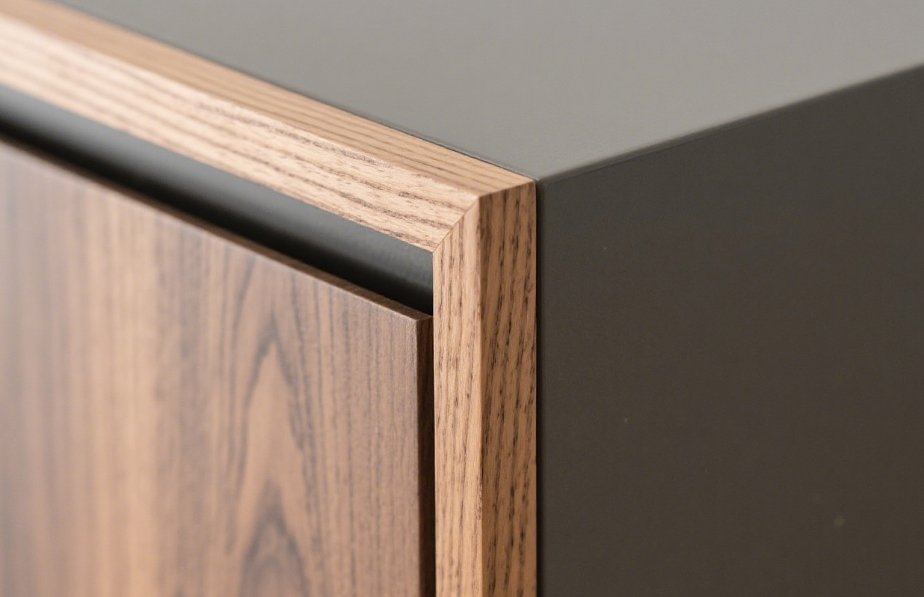
The first step is simple. I calculate the length of every furniture edge that will receive edge banding.
The key is to calculate the edges, not the total surface area of the furniture panel.
Start with the furniture drawing
Before I calculate anything, I check the furniture drawing or cutting list.
I need to know:
- Panel length
- Panel width
- Quantity
- Which edges require banding
- Which edges remain exposed
- Which edges receive another finishing method
For a rectangular cabinet door, I may need to band all four sides. For an internal shelf, I may only need to band the front edge.
Use a simple edge-length formula
For a rectangular panel where all four edges need banding:
Edge Length = 2 × (Length + Width)
For example, if one cabinet door measures 600 mm × 400 mm:
2 × (600 + 400) = 2,000 mm
So one door requires 2 meters of theoretical edge banding.
If I have 50 identical doors:
2 m × 50 = 100 m
The theoretical requirement is therefore 100 meters.
However, this is not yet my final purchasing quantity.
Calculate different components separately
Real furniture production often contains many panel sizes.
I prefer to calculate each group separately.
| Panel Type | Size | Quantity | Edges to Band | Theoretical Length |
|---|---|---|---|---|
| Cabinet Door A | 600 × 400 mm | 50 | 4 sides | 100 m |
| Cabinet Door B | 700 × 450 mm | 30 | 4 sides | 69 m |
| Shelf | 800 × 300 mm | 40 | Front only | 32 m |
| Side Panel | 1800 × 600 mm | 20 | Front only | 36 m |
In this example, the total theoretical requirement is:
100 + 69 + 32 + 36 = 237 meters
This approach gives me better control because I can see exactly where the material is being used.
Do not forget special furniture designs
Curved panels, irregular shapes, split panels, and decorative components can change the calculation.
I also need to check whether the same PVC edge banding color is used across different components.
If five different colors are used, I should calculate each color separately.
That prevents me from combining all requirements into one number that is difficult to use during purchasing.
How Should You Account for Cutting Waste and Production Loss?
The theoretical edge length is only the starting point. Real production almost always creates some level of material loss.
I should not use one fixed waste percentage for every factory because different machines, operators, cutting methods, roll lengths, product specifications, and production plans can create different results.
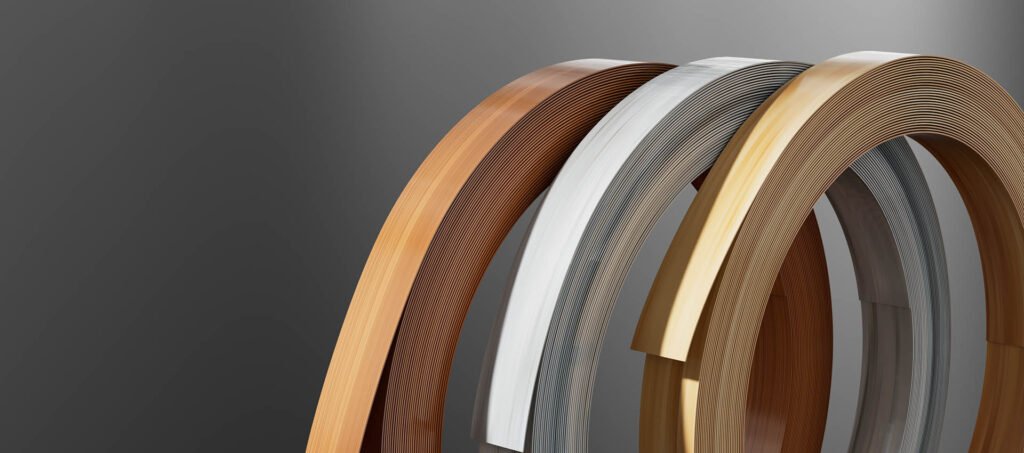
Where does edge banding waste come from?
I usually divide waste into several categories.
1. Cutting waste
A long roll may need to be cut into smaller lengths. The leftover pieces may not always be useful for the next panel.
2. Setup waste
The production line may require material during machine setup, adjustment, or testing.
3. Processing waste
Some material may be lost because of cutting, trimming, joining, or other processing operations.
4. Quality rejection
A section may not meet the required appearance or processing standard.
5. Short leftover pieces
A leftover piece may technically be usable, but its length may not be enough for the next furniture component.
This is why I prefer to use a historical waste factor instead of blindly using a number such as 5% or 10%.
Use your own production data
The basic formula is:
Required PVC Edge Banding = Theoretical Edge Length × (1 + Waste Rate)
For example, if the theoretical requirement is 237 meters and the factory has measured a 6% average waste rate for similar jobs:
237 × 1.06 = 251.22 meters
The purchasing requirement becomes about 251.22 meters before considering supplier packaging or minimum order quantities.
The important point is that the 6% in this example is not a universal industry standard. It is a sample calculation. I would use my own production records to determine the actual rate.
Track waste by product and process
I can make the calculation more accurate by tracking waste separately.
| Waste Source | What I Track |
|---|---|
| Setup | Material used before stable production |
| Cutting | Length lost during cutting |
| Processing | Material lost during application |
| Rejection | Material rejected after inspection |
| Leftovers | Material that cannot be reused |
This method also helps me find the real cause of high consumption.
ISO recommends using monitoring, measurement, analysis, and evaluation as part of quality management. ISO also points to statistical process control as one method for detecting process variation.
For me, this means the best waste rate is not a number copied from another factory. It is a number built from my own production data.
How Do You Convert Furniture Edge Measurements into the Right PVC Edge Banding Order Quantity?
After I calculate the theoretical edge length and production waste, I still need to turn the result into a practical purchasing quantity.
This step is important because suppliers may sell PVC edge banding in rolls, cartons, or other fixed packaging units.
Start with the total requirement
Suppose my production plan requires:
237 meters theoretical edge length
My historical waste rate is:
6%
My adjusted requirement is:
237 × 1.06 = 251.22 meters
If my supplier can provide the exact quantity, I may order around 252 meters.
But suppose the supplier packs the material in 50-meter rolls.
Then:
251.22 ÷ 50 = 5.0244 rolls
I cannot order 5.0244 rolls.
I need to order:
6 rolls × 50 meters = 300 meters
This gives me 48.78 meters above the calculated requirement.
Packaging changes the final order
This is why I separate three numbers:
| Stage | Quantity |
|---|---|
| Theoretical requirement | 237 m |
| Adjusted production requirement | 251.22 m |
| Actual purchase quantity | 300 m |
The final purchase quantity is not always equal to the calculated requirement.
I also need to consider future production.
If I know that the same color will be used again next week, buying the full roll may not be a problem. If the color is a special custom color for a single project, I need to be more careful.
Color-specific purchasing matters
I do not combine different colors when I calculate inventory.
For example:
- White: 500 m
- Oak: 350 m
- Walnut: 200 m
- Custom Grey: 120 m
Each color has its own demand pattern.
A standard color may have regular future demand. A custom color may have very limited future demand.
I therefore use different purchasing strategies for each SKU.
Supplier packaging should be included early
When I request a quotation, I ask the supplier about:
- Roll length
- Packing method
- MOQ
- Available stock
- Custom production quantity
- Lead time
REHAU, for example, publishes technical information and standard tolerance documents for different edgeband materials, and it provides tools for matching edgebands with panels. This shows why product specification and technical information should be part of the purchasing discussion, rather than something checked only after an order is placed.
How Can Manufacturers Improve PVC Edge Banding Purchasing Accuracy and Reduce Material Waste?
I do not believe that one calculation can solve material waste forever. The better approach is to create a repeatable system.
I can improve purchasing accuracy by connecting product design, production data, inventory, and supplier information.
Build a standard calculation sheet
I recommend keeping these fields in one spreadsheet or ERP system:
| Data Field | Example |
|---|---|
| Product ID | CAB-001 |
| Panel size | 600 × 400 mm |
| Quantity | 50 |
| Edges to band | 4 |
| Edge banding color | White |
| Width | 22 mm |
| Thickness | 2 mm |
| Theoretical length | 100 m |
| Waste rate | 6% |
| Purchase quantity | 150 m |
This structure makes the calculation easier to repeat.
Compare planned use with actual use
After production, I compare:
Planned quantity vs actual consumption
For example:
Planned: 251 m
Actual: 260 m
The difference is 9 meters.
I then ask why the difference happened.
Maybe the cutting plan was inefficient. Maybe the machine setup consumed more material. Maybe the project had more rejected pieces.
This creates useful production data for the next order.
Improve cutting plans
I can also reduce waste by grouping components with similar dimensions.
If several pieces can be cut from the same continuous length, I may reduce leftover material.
This is especially useful for large furniture orders with many repeated components.
Work with suppliers on purchasing data
A good PVC edge banding supplier should not only quote a price. The supplier should also help me understand:
- Standard roll lengths
- Custom production options
- MOQ
- Available colors
- Lead times
- Packaging units
This information helps me turn a theoretical requirement into a practical purchasing plan.
Use actual data instead of fixed assumptions
My final rule is simple:
Measure → Calculate → Produce → Compare → Improve
I first measure the actual furniture edges. I calculate the theoretical demand. I add a waste rate based on production records. I compare the plan with actual consumption. Then I improve the next calculation.
This approach follows the same basic process thinking used in modern quality management. ISO explains that organizations can identify processes, define controls, monitor performance, analyze results, and improve based on evidence.
When I apply this approach to PVC edge banding, purchasing becomes more predictable. I can reduce unnecessary stock without creating material shortages.
Conclusion
Accurate PVC edge banding calculation helps me control costs, reduce waste, avoid shortages, and make better purchasing decisions for furniture production.
Data Sources
- ISO — ISO 9001 Quality Management Systems: ISO explains process control, measurement, evaluation, and continual improvement in quality management.
ISO 9001 — Quality Management Systems - ISO — The Process Approach in ISO 9001:2015: This document explains process identification, control, monitoring, measurement, and improvement.
ISO Process Approach Guide - ISO — Quality Assurance: A Critical Ingredient for Organizational Success: ISO discusses material testing, performance testing, statistical process control, measurement, and continuous improvement.
ISO Quality Assurance Guide - REHAU — RAUKANTEX Tools & Services: REHAU provides technical information, processing specifications, standard tolerances, and edgeband matching tools for furniture applications.
REHAU RAUKANTEX Tools & Services