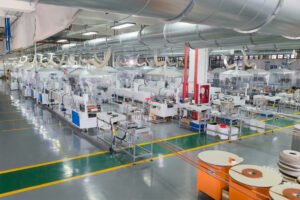

Problem: Your line stalls from bad trim or color issues.
Agitation: That costs time, money, and customers.
Solution: I show clear benefits of working with a professional PVC edgeband maker.
Working with a pro manufacturer gives steady color, lower total cost, faster lead times, and reliable service. I picked the points that matter to buyers and auditors.

I have audited factories and managed supply switches. I will show what a real partner brings and how it affects your bottom line. Read on and you will know what to ask and expect.
How Professional Manufacturers Deliver More Stable Quality and Color Consistency?
Problem: Color shifts and variable quality create returns.
Agitation: Visual checks alone do not stop subtle drift.
Solution: Pro factories use precise systems and labs.
Professional makers use inline spectrophotometers and color labs. They log Lab* readings and Delta E trends. They keep master samples under standard light. These systems stop color drift earlier and reduce rework.
Dive deeper
What systems they use
I look for inline spectrophotometers and benchtop labs. These devices read color as numbers. The numbers let the factory control dosing and correct in real time. That avoids long runs of out-of-tolerance product. X-Rite and HunterLab make these systems and they are common in serious plants.
Master samples and light booths
A master sample sits in a controlled light booth. The factory uses it as the visual target. They keep the sample with the spectrophotometer profile. If a run drifts, they can compare the live read to the master. This practice makes repeat orders match previous deliveries.
Process control and documentation
Pro factories do more than measure. They record the process profile for each lot. They log temperatures, line speed, and feeder settings. They link these logs to the batch. That traceability speeds root-cause work if a customer reports a problem.
| Capability | Why it matters | What I request |
|---|---|---|
| Inline spectro | Real-time control | Trend charts for runs |
| Master sample | Visual target | D50 booth photo + spec file |
| Process logs | Traceability | Batch records per roll |
I ask suppliers for recent trend charts and one retained sample per lot. I will not accept “we check visually” as the full answer. Objective data matters.
Why In-House Production Lowers Your Long-Term Material and Labor Costs?
Problem: Low quoted price hides hidden costs.
Agitation: Outsourced assembly and rework add labor and time.
Solution: In-house production reduces steps and cost leaks.
When a factory makes the film, the compound, and the edge tape, it cuts markups and hand-offs. That reduces transport, handling, and rework steps. It also lowers labor per finished meter because automation replaces manual tasks. I measured this in multiple supplier moves. The total landed cost fell even if the invoice price change was small.
Dive deeper
How costs stack up
I break total cost into unit price, scrap & rework, labor, and logistics. A low unit price only looks good if scrap is low and deliveries are steady. In-house makers control those drivers better.
Unit price vs. total cost
A trading middleman can add 8–20% margin. They also add handling and consolidation fees. A factory that manages resin, masterbatch, and extrusion avoids those margins. The result is a lower total cost per meter.
Labor and automation
Edge banding and extrusion lines now use automation for trimming, winding, and inspection. Automation cuts manual labor and the variation that causes scrap. A factory with modern edgebanders and inline trimming saves on labor and reduces defects.
Reduced touch points
Each hand-off risks damage and error. In-house production keeps hand-offs low. That lowers handling damage, mis-labeling, and lost time. Those savings are real when measured over months.
| Cost element | Middleman route | In-house manufacturer |
|---|---|---|
| Unit price | Lower or similar | Competitive |
| Scrap & rework | Higher risk | Controlled with QC |
| Labor | Higher overall | Lower per unit with automation |
| Logistics | More touch points | Fewer touch points |
I always calculate landed cost, not just invoice price. In-house production often wins on that metric.
How Advanced Machinery and Large Capacity Improve Lead Times and Supply Stability?
Problem: Long lead times force big stockpiles.
Agitation: Stock ties working capital and risks obsolescence.
Solution: Advanced lines and spare capacity shorten lead time.
Modern twin-screw extruders and high-speed edgebanders run faster and handle complex formulas. They let a factory run more SKUs without long changeovers. Large capacity also means they can absorb peaks. AMUT and other OEMs promote these benefits. Faster lines cut lead time and lower inventory needs.

Dive deeper
Machine capability and flexibility
I check whether the plant uses twin-screw extrusion for complex compounds. Twin-screw units offer better mixing and stability. I also check quick-change tooling and modular dies. These reduce change-over time and waste. Modern winding systems and tension controls improve roll quality and reduce scrap.
Capacity and redundancy
I ask for line count and utilization rates. A factory with spare lines can move orders in case of breakdowns. That redundancy avoids single-point failure. I prefer suppliers with documented MTBF and spare parts stock.
Lead-time math
Shorter lead time reduces safety stock. JIT and VMI can work if the factory can deliver consistently. NetSuite and other sources show that JIT can cut inventory by 20–50% in practice. When lead time drops, your working capital improves and your fresh-SKU risk falls.
| Capability | Benefit | What I verify |
|---|---|---|
| Twin-screw extruder | Better mixing, stability | Specs and sample runs |
| Quick-change tooling | Lower change-over waste | Change-over time proof |
| Multiple lines | Peak handling | Utilization reports |
I once moved a program to a plant with modern lines. Lead time fell by two-thirds. My warehouse turns improved and rush freight disappeared.
Why Technical Support and Customization Make Your Product Development Faster?
Problem: Slow technical help delays launches.
Agitation: Fixes after production add cost.
Solution: A supplier with technical depth speeds development.
Professional manufacturers offer lab support, color formulation, and on-site troubleshooting. They can run small custom trials and tune recipes. That reduces development cycles and lowers the cost of new SKUs.
Dive deeper
Lab services and trials
I value a supplier who provides lab trials with spectro reports. They can make color matches and test adhesion, UV stability, and heat behavior. These trials cut surprises in full runs.
Co-development and small batch runs
Customization often needs small batches. Pro shops run small runs with low MOQ and keep records. They also advise on cost vs. performance trade-offs. That guidance saves design rework and shortens time to market.
Response and escalation
Technical support matters after the sale. I test response time before awarding a big program. I check if they send technicians for urgent line issues. Fast escalation prevents months of lost output.
| Service | Benefit | Ask for |
|---|---|---|
| Lab trials | Confirm performance | Trial report + spectro data |
| Small-batch runs | Validate customization | MOQ and turnaround time |
| On-site support | Fast fix | SLA for technician visit |
Good support lets me push new designs faster and with less risk.
How Strict Quality Systems Reduce Reject Rates and Improve Production Efficiency?
Problem: High rejects increase unit cost and waste.
Agitation: Quality failures hurt production rhythm.
Solution: Formal QMS reduces errors and speeds fixes.
A certified QMS and SPC practices lower variation and catch trends early. They also make corrective actions real and documented. This reduces repeat failures and improves efficiency.
Dive deeper
QMS basics I look for
I treat ISO 9001 as the baseline. I then look for SPC charts, NCR logs, and CAPA records. These show that the factory finds root causes and fixes them. A mature QMS also documents training and maintenance.
Process control on the line
Inline checks, camera inspection, and automatic feeders cut human error. SPC keeps the process inside control limits. When a value drifts, the team reacts fast. That prevents whole rolls from going bad.
Measured impact
I compare reject rates and OTIF before and after QMS improvements. Good plants show steady improvement. Fewer rejects mean lower per-unit cost and less admin overhead.
| QMS element | Role | Evidence I request |
|---|---|---|
| SPC | Detect trends | Control charts |
| NCR logs | Fix issues | Closure records |
| Maintenance plan | Avoid breakdowns | Planned maintenance schedule |
A strong QMS gives me confidence. It makes buying decisions simple.
Conclusion
A professional PVC edgeband partner gives predictable quality, lower total cost, and faster time to market. Use these checks when you pick a supplier.
Data sources & links
- HunterLab — In-Line and In-Process Spectrophotometers. https://www.hunterlab.com/en/products/in-line-in-process-spectrophotometers/. (HunterLab)
- X-Rite — Inline Spectrophotometers & Color Measurement Systems. https://www.xrite.com/categories/inline-spectrophotometers. (xrite.com)
- NetSuite — Just-in-Time (JIT) Inventory Guide. https://www.netsuite.com/portal/resource/articles/inventory-management/just-in-time-inventory.shtml. (NetSuite)
- AMUT / Extrusion equipment sources — Benefits of modern extrusion for capacity and quality. https://www.yjing-extrusion.com/why-choose-amut-extrusion-equipment-for-your-manufacturing-needs.html. (YeJing Machinery)
- Wurth/Baer — Edgebander productivity and cost benefits. https://www.wurthbaermachinery.com/article-increase-production-higher-profits-edgebander-machine/. (wurthbaermachinery.com)