

A good-looking sample can hide serious problems. If I approve mass production too early, I may face color differences, poor adhesion, customer complaints, and costly rework.
I verify edge banding samples by checking product specifications, measuring dimensions, testing surface quality and bonding performance, comparing color consistency, and setting clear acceptance criteria. I approve mass production only when the samples meet agreed requirements under the intended processing conditions.
When I work with an edge banding manufacturer, I treat sample approval as a quality checkpoint, not a simple formality. A sample helps me understand what the factory can produce, but it does not automatically prove that every roll in a bulk order will meet the same standard. I need a clear testing process that both the manufacturer and I can follow. I also need written records so that we can compare mass production with the approved sample if a problem appears later. Here is how I approach each step before I approve a large order.
What Specifications Should Distributors Confirm Before Testing Edge Banding Samples?
A sample may look right, but the wrong thickness, width, material, or finish can still make it unsuitable for my customers. If I test a product without confirming its specifications, I may approve something that does not match the original order.
I confirm the material, dimensions, color, surface finish, texture, application, and packaging requirements before testing. I also ask the manufacturer to record these details in a written specification sheet. This gives me a clear standard for checking the sample and the final production batch.
I Start With the Product Specification Sheet
I first confirm what the customer actually needs. For PVC edge banding, I record the material, thickness, width, color reference, surface finish, texture, and roll length. If the order involves ABS, acrylic, or another material, I make sure the sample uses the correct material rather than assuming that similar-looking products will perform in the same way.
I also confirm the intended panel material and application. Edge banding for a particular furniture panel may need to work with a specific adhesive and processing setup. The manufacturer needs this information before it prepares a sample for approval.
I pay special attention to dimensions. A sample that measures 1 mm thick may not be suitable if the agreed specification calls for a different thickness. I do not rely on product names or general descriptions. I ask the manufacturer to state the target dimensions and acceptable tolerances in writing.
I Check Appearance and Application Requirements
I also record the required color, gloss level, texture, and pattern. A customer who needs a matte wood-grain finish may reject a sample with a similar color but a different surface effect. I use a physical reference sample or an agreed color reference whenever possible.
I confirm the packaging requirements as well. Roll length, labels, product codes, and protective packaging can affect warehouse handling and order fulfillment. These details may not change the material’s performance, but they still matter to the distributor and the final customer.
| Specification | What I confirm | Why it matters |
|---|---|---|
| Material | PVC, ABS, acrylic, or another agreed material | Different materials may behave differently during processing. |
| Thickness and width | Target measurements and acceptable tolerances | Incorrect dimensions may cause fitting or processing problems. |
| Color and texture | Approved reference and surface finish | Similar colors may still look different on finished furniture. |
| Application | Panel type, adhesive, and processing conditions | The sample must suit the intended use. |
| Roll length and packaging | Quantity, labels, and protection | Clear packaging requirements help prevent order errors. |
| Identification | Sample number, product code, and specification version | Both sides can identify the exact approved product. |
I Keep a Record of the Approved Sample
I label the sample with its product code, material, dimensions, color reference, and approval date. I also keep photographs and a copy of the specification sheet. When possible, I ask the manufacturer to retain a matching reference sample.
This step becomes especially important when I reorder the same product months later. A verbal agreement may leave room for different interpretations, but a written specification and an identified reference sample give both sides something concrete to check.
I do not approve a sample if important details remain unclear. I first resolve the differences and ask for a corrected sample if necessary. This may add time at the beginning, but it helps me avoid a much larger problem after the factory has produced thousands of meters of edge banding.
How Can Distributors Inspect Edge Banding Samples for Dimensional Accuracy and Surface Quality?
A sample can look fine at first glance and still have uneven dimensions or small surface defects. These problems may become more visible when the edge banding is applied to a panel or viewed under strong lighting.
I inspect dimensions with suitable measuring tools and check the surface under consistent lighting. I look for scratches, color marks, uneven edges, bubbles, and other visible defects. I compare the results with the written specifications instead of judging the sample only by appearance.

I Measure Thickness and Width at Several Points
I use a suitable caliper or thickness gauge to check the sample. I take measurements at several points rather than measuring only one spot. This helps me identify variation along the sample.
I record the results and compare them with the agreed tolerance. I do not assume that every edge banding product has the same acceptable tolerance. The requirement should match the product specification, the intended application, and the agreement between the buyer and manufacturer.
I also check whether the edges are straight and whether the roll shows obvious deformation. If the product is supplied in rolls, I inspect the material from different sections where practical. One good measurement does not prove that the entire roll is consistent.
I Inspect the Surface Under Controlled Conditions
I examine the sample under lighting that makes surface defects easy to see. I look for scratches, stains, uneven gloss, bubbles, visible particles, and printing or texture problems. For wood-grain designs, I compare the pattern with the approved reference.
I also check whether the appearance changes noticeably when I view the sample from different angles. This can matter for products with a special gloss level or textured finish. I use the same viewing conditions when comparing different samples so that lighting does not create a false impression.
My Basic Inspection Checklist
| Inspection item | How I check it | What I record |
|---|---|---|
| Thickness | Measure at several points | Individual readings and agreed tolerance |
| Width | Measure across the strip | Width readings and any visible variation |
| Surface appearance | Inspect under consistent lighting | Scratches, marks, bubbles, and other defects |
| Color and pattern | Compare with the approved reference | Visible differences and viewing conditions |
| Edge condition | Inspect both sides of the strip | Uneven edges, deformation, or damage |
| Roll condition | Check winding and visible sections | Creases, damage, and other handling issues |
I Separate Visible Defects From Functional Problems
Not every visible difference has the same impact. A small cosmetic mark may affect appearance but not processing. A dimensional problem may affect trimming or fitting. I classify defects based on the agreed requirements and the effect on the finished product.
I also avoid making decisions from photographs alone. Camera settings, screen brightness, lighting, and image compression can change how a color or surface appears. I use photographs for records, but I prefer physical samples for final color and texture approval.
If I find a problem, I record its location, take a clear photograph, and compare it with the specification. I then ask the manufacturer to explain whether the issue comes from the material, production process, or sample handling. I do not move to mass production until we agree on what needs to change and confirm the revised sample.
This process gives me a repeatable way to inspect edge banding. It also makes the approval decision easier to explain to my customer and the manufacturer.
What Tests Can Verify Edge Banding Adhesion and Processing Performance?
A sample may pass a visual inspection and still fail during edge banding. Poor bonding, rough trimming, or lifting edges can create problems for furniture manufacturers and increase production waste.
I test edge banding with the intended panel, adhesive, and machine settings whenever possible. I check bonding, trimming, edge appearance, and processing stability. I also record the test conditions because results can change when the adhesive, temperature, pressure, or feed speed changes.
I Test the Sample Under Realistic Conditions
I first confirm the equipment and materials that my customer will use. I then apply the edge banding to a representative panel and follow the agreed processing instructions. I check whether the strip bonds evenly and whether the finished edge looks clean.
I inspect the bond along the full test section. I look for lifting, gaps, bubbles, or areas where the edge banding separates from the panel. I also check the trimmed edge for visible glue lines, rough cuts, chipping, or other problems that matter to the customer’s finish requirements.
I do not judge the edge banding alone if the test setup is not controlled. Adhesive selection, panel condition, machine settings, and application technique can all affect the result. If bonding fails, I check these factors with the manufacturer before deciding that the edge banding itself is defective.
I Check Bonding and Processing Separately
I treat bonding performance and machining performance as two related but different checks. Strong bonding does not guarantee clean trimming, and a clean cut does not prove that the bond will remain stable.
For bonding, I check whether the strip stays attached under the agreed test conditions. If the customer requires a measured peel or separation force, I agree on a suitable method with the manufacturer or a qualified testing laboratory. I do not apply a random force threshold without a product-specific basis.
For processing, I check whether the edge banding runs through the intended equipment without repeated problems. I look at trimming, surface damage, edge lifting, and the appearance of the finished panel. I record the machine settings so that another test can use the same conditions.
What I Record During Performance Testing
| Test area | What I do | What I look for |
|---|---|---|
| Bonding | Apply the sample to the agreed panel with the intended adhesive | Even attachment, gaps, lifting, or separation |
| Trimming | Process the panel using the intended setup | Clean edges, rough cuts, and visible damage |
| Surface after processing | Inspect the finished panel | Scratches, marks, and changes in appearance |
| Process stability | Repeat the test where practical | Whether the result remains consistent |
| Test conditions | Record panel, adhesive, temperature, pressure, and feed speed where applicable | Whether the test can be repeated fairly |
I Use Test Standards Only When They Fit the Product
I also check whether a recognized test method is suitable for the property I need to evaluate. For example, ASTM D3330/D3330M describes methods for measuring the peel adhesion of pressure-sensitive tapes. It is not automatically the correct method for measuring the bond between hot-melt edge banding and a furniture panel. I choose a method that matches the actual material and application.
I make the same distinction with coating tests. ISO 2409 describes a cross-cut test for assessing resistance to separation of paint and varnish coatings. It does not directly establish the bonding performance of an edge banding strip attached to a panel. I do not use a standard simply because it includes the word “adhesion.”
If a customer has a specific performance requirement, I agree on the test method, equipment, conditioning period, and acceptance limit before testing begins. This helps me compare results fairly and avoid disagreements after production. The goal is to confirm that the sample performs under the conditions that matter to the customer, not to collect test results that do not match the intended application.
How Can Distributors Check Color Consistency and Batch-to-Batch Stability?
A sample may match my color requirements today, but the next production batch may look different. This can create problems for distributors who supply the same color to furniture manufacturers over several months.
I compare samples with an approved physical reference and check color, gloss, texture, and pattern under consistent conditions. I also ask the manufacturer how it controls color during production and records each batch. I want to know whether the factory can reproduce the approved appearance, not just produce one attractive sample.
I Use a Physical Reference Sample
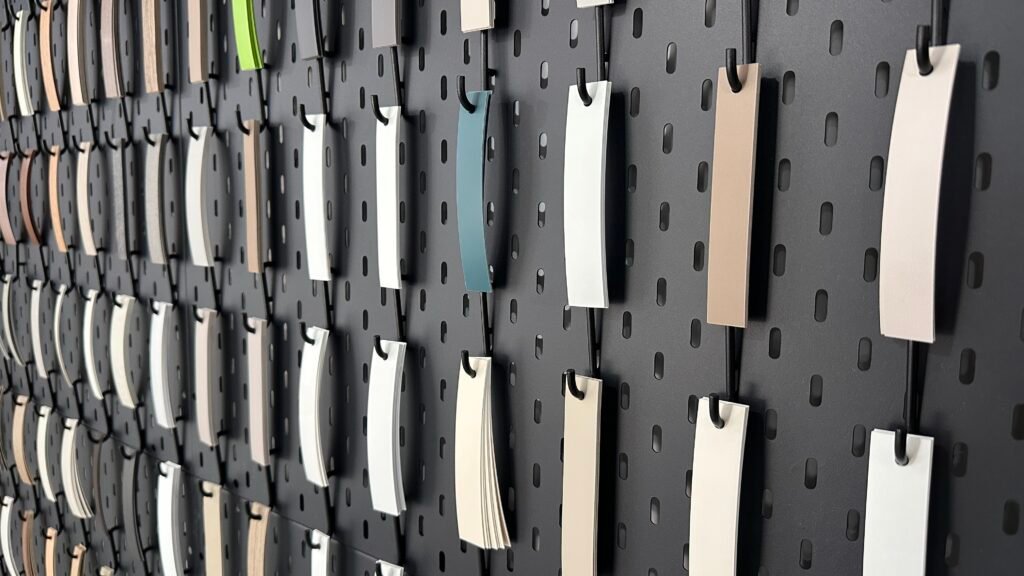
I keep an approved physical sample for every important color and finish. I label it with the product code, approval date, and specification version. I also ask the manufacturer to keep a matching reference sample when possible.
I compare new samples with the reference under the same lighting conditions. I check the main color, gloss level, grain pattern, and surface texture. I avoid comparing one sample under warm indoor lighting and another under daylight because lighting can change how colors appear.
I also treat digital color values as supporting information rather than a complete replacement for physical samples. Screens and printing systems may show colors differently. For products where a small color difference matters, I agree on a suitable color measurement method and acceptance limit with the manufacturer.
I Check Whether the Manufacturer Can Repeat the Result
I ask the manufacturer how it manages color matching during production. The factory may use approved color references, production records, color measurement equipment, or other controls. I want to understand which methods apply to my product and how the factory responds when a batch falls outside the agreed range.
I also ask how it records material batches, production dates, and product codes. These records can help both sides investigate a color difference later. If the manufacturer cannot identify which materials and production conditions relate to an order, it may be harder to find the cause of a problem.
I do not assume that every material or finish uses the same color tolerance. I agree on the method and acceptable difference based on the product, customer expectations, and available testing process.
How I Compare Samples and Production Batches
| Check | What I compare | What I want to confirm |
|---|---|---|
| Main color | New sample against the approved reference | The color remains within the agreed range |
| Gloss | Surface reflection under consistent lighting | The finish matches the required appearance |
| Texture | Surface feel and visible pattern | The texture remains consistent |
| Pattern | Grain direction, print detail, and pattern appearance | The design meets the approved reference |
| Batch records | Product code, material batch, and production date | The factory can trace the relevant production run |
| Repeat orders | New order against retained reference samples | The manufacturer can reproduce the agreed specification |
I Do Not Confuse a Matching Sample With Guaranteed Batch Consistency
A matching sample is a useful starting point, but it is not proof that the whole order will match. I ask how the manufacturer checks color during mass production and whether it keeps samples from finished batches.
For a large or high-value order, I may request a pre-production sample and a sample from the actual production run. I compare them before approving shipment when the order agreement allows this step. If the color differs, I ask the factory to investigate and provide a clear explanation before I accept the goods.
I also discuss what happens if a future batch does not meet the approved standard. The agreement should explain how the parties will inspect the product, record the difference, and decide on corrective action. This helps me manage repeat orders with fewer surprises.
What Acceptance Criteria Should Distributors Set Before Approving Mass Production?
If I approve a sample without written acceptance criteria, the manufacturer and I may have different ideas about what “good quality” means. That difference can become an expensive dispute after production is complete.
I set clear acceptance criteria for dimensions, appearance, bonding performance, processing results, packaging, and batch identification. I also agree on inspection methods, sampling plans, and procedures for handling failed results. I use these requirements to decide whether the sample is ready for mass production.

I Turn Sample Results Into Written Requirements
I document the results from the approved sample and turn them into requirements for the production order. These requirements include target dimensions, allowed tolerances, color references, surface finish, and any agreed performance tests.
I also state which requirements are critical to the customer’s use. For example, a dimensional issue that prevents correct application may need different treatment from a minor appearance issue that falls within the agreed limits. I define these categories before production instead of deciding after I see the goods.
I make sure the manufacturer agrees to the same requirements. I do not rely only on a purchase order that lists the product name and quantity. I attach or reference the relevant specification sheet, approved sample, and testing conditions.
I Agree on an Inspection and Sampling Plan
I also decide how the factory or inspector will check the mass-produced goods. For a small order, I may inspect the available rolls directly. For a larger order, I may use a defined sampling plan based on the lot size, risk, and customer requirements.
ISO 2859-1:2026 provides sampling schemes for inspection by attributes, including plans indexed by the acceptance quality limit (AQL). I can use this standard as a reference when setting a suitable sampling process with the manufacturer or inspection provider. The correct plan depends on the agreed inspection level, lot size, and acceptance criteria. I do not assume that one sample size or AQL value is right for every edge banding order. Source: ISO 2859-1:2026.
I also make clear that passing a sample inspection does not guarantee that every item is defect-free. Sampling helps me make a decision based on a defined inspection plan, but it cannot remove all quality risk.
My Mass Production Approval Checklist
| Approval item | Requirement I define | Evidence I keep |
|---|---|---|
| Product specifications | Material, dimensions, finish, and tolerances | Signed or confirmed specification sheet |
| Appearance | Approved color and surface reference | Retained physical sample and photographs |
| Performance | Agreed bonding and processing tests | Test results and recorded conditions |
| Batch consistency | Identification and traceability requirements | Batch records and retained production samples |
| Inspection plan | Sampling method and acceptance rules | Inspection plan and report |
| Packaging | Roll length, labels, and protective packaging | Approved packaging requirements |
| Problem handling | Process for reporting and resolving defects | Written agreement on corrective action |
I Approve Production Only After the Key Questions Are Answered
Before I approve mass production, I ask whether the sample matches the written specifications, whether it passes the required checks, and whether the manufacturer understands the acceptance criteria. I also confirm that the production team will follow the approved sample and specification.
If a sample fails, I document the problem and request a corrected sample. I do not accept a verbal promise that the issue will disappear during mass production. If the factory changes the material, surface finish, or another important part of the specification, I review whether the change requires a new sample approval.
I keep the final approval in writing. The record should identify the product, specification version, approved sample, testing results, and approval date. This gives both sides a clear reference if a quality issue appears during or after production.
I also separate sample approval from final shipment acceptance. Sample approval confirms that the agreed reference meets the requirements. The production order still needs to follow the agreed inspection and acceptance process. This distinction helps me control quality from the first sample to the delivered goods.
Conclusion
I approve edge banding mass production only after I verify specifications, inspect dimensions and appearance, test performance, compare color consistency, and agree on written acceptance criteria.
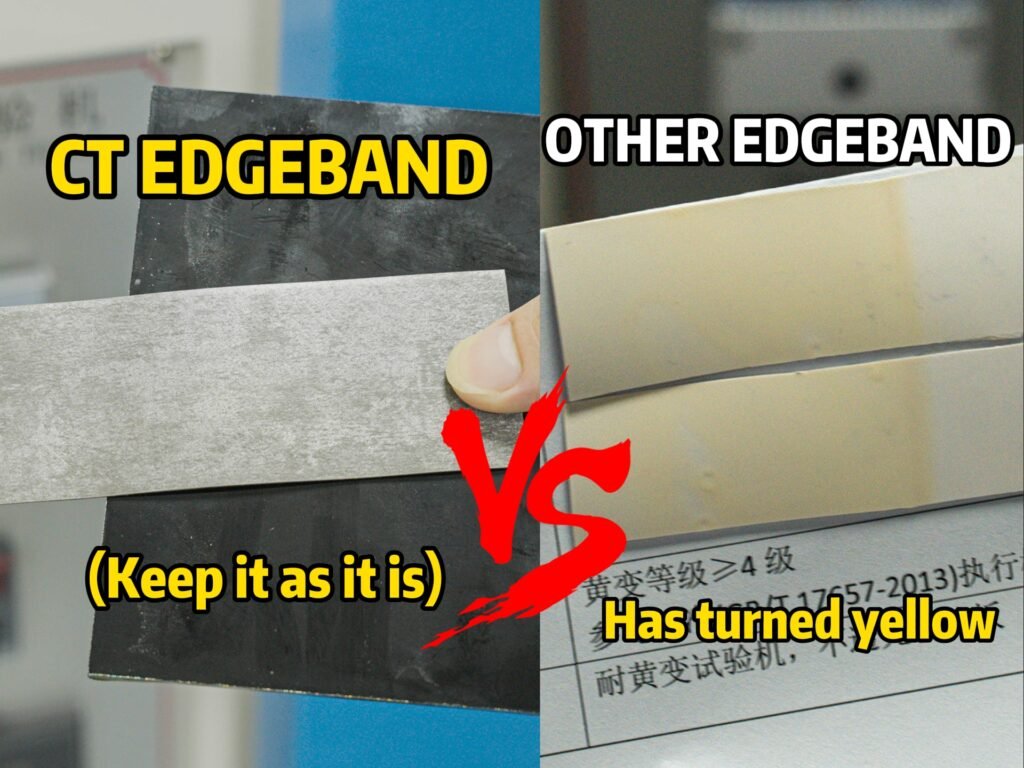
How We Test Edge Banding
Yellowing, adhesion, moisture and dimension testing — the lab behind every batch you receive.
See our testing lab
Data Sources and References
- International Organization for Standardization (ISO) — ISO 2859-1:2026: Sampling Procedures for Inspection by Attributes
https://www.iso.org/standard/2859-1 - ASTM International — ASTM D3330/D3330M: Standard Test Method for Peel Adhesion of Pressure-Sensitive Tape
https://webstore.ansi.org/standards/astm/astmd3330d3330m042025 - International Organization for Standardization (ISO) — ISO 2409:2020: Paints and Varnishes — Cross-Cut Test
https://www.iso.org/standard/76041.html
Working with a supplier who can back up sample quality with documented test results makes the approval process far easier. Chaotai Edge Banding supplies PVC, ABS, MABS and acrylic edge banding with accurate color matching, batch-level test reports and factory-direct support for distributors and furniture manufacturers worldwide.