

Many furniture factories struggle with inconsistent PVC edge banding. Poor quality leads to peeling, whitening, and costly rework.
PVC edge banding quality starts with raw materials, continues through extrusion and production, and relies on strict testing and defect control to ensure finished rolls meet standards.

I have spent years auditing edge banding suppliers. I noticed that factories with clear quality control from raw material to finished roll avoid most common defects.
Why Raw Material Selection Determines PVC Edge Banding Quality?
Low-grade or inconsistent materials cause problems that appear only after production. Many buyers focus on price and ignore material quality.
The right PVC resin, stabilizers, and pigments form the foundation for edge banding that adheres well, stays color-stable, and resists whitening.

Dive deeper Paragraph:
Raw material selection is not just a supplier decision. I always verify it before production begins.
PVC Resin Quality
The type and quality of PVC resin affect flexibility and adhesion.
| Factor | What I Check | Why It Matters |
|---|---|---|
| Resin type | PVC granule grade | Determines extrusion stability |
| Softening point | Correct heat range | Prevents edge cracking |
| Fillers | Content and type | Avoid brittleness |
Stabilizers and Additives
They prevent yellowing and improve heat resistance.
| Additive | Function |
|---|---|
| Thermal stabilizer | Prevents color change |
| UV stabilizer | Reduces fading under light |
| Plasticizer | Controls flexibility |
Pigment Consistency
Uniform color ensures batch-to-batch stability.
| Test | Method |
|---|---|
| Spectrophotometer | Color measurement |
| Sample comparison | Batch matching |
Selecting the right raw materials reduces defects in the finished rolls and ensures longer shelf-life.
How Extrusion and Production Processes Affect Consistency and Performance?
Even top-quality PVC can fail if the extrusion process is poor. Temperature, screw speed, and cooling must be precise.
Extrusion and production processes directly impact thickness accuracy, surface finish, and adhesion consistency.

Dive deeper Paragraph:
I focus on three areas: extrusion control, cooling, and trimming.
Extrusion Control
Proper extrusion stabilizes the material.
| Parameter | Typical Issue if Poor | Impact |
|---|---|---|
| Temperature | Overheating | Gloss variation, degradation |
| Screw speed | Too fast or slow | Uneven thickness |
| Pressure | Inconsistent | Curling or waves |
Cooling System
Even cooling prevents warping.
| Cooling Method | Benefit |
|---|---|
| Water bath | Uniform thickness |
| Air cooling | Reduces stress |
| Roller alignment | Flatness control |
Trimming and Finishing
Accurate trimming ensures ready-to-use rolls.
| Step | Key Check |
|---|---|
| Cutting blade | Sharpness, alignment |
| Edge width | Within ±0.05 mm |
| Surface inspection | No scratches or whitening |
When extrusion, cooling, and trimming are stable, defects drop significantly, even in high-volume production.
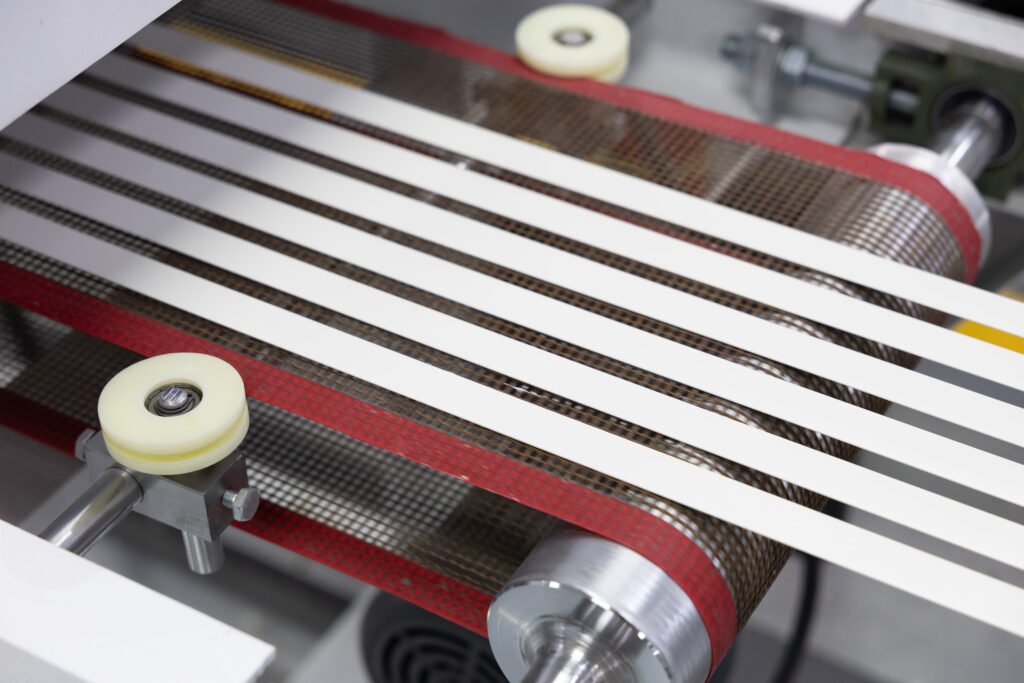
What Key Tests Ensure Adhesion, Thickness, and Surface Finish Meet Standards?
Testing verifies performance before rolls leave the factory. Skipping tests risks returns and customer complaints.
Critical tests include adhesion strength, thickness measurement, surface inspection, and heat resistance.
Dive deeper Paragraph:
I classify tests into physical, visual, and functional.
Adhesion Tests
Ensures glue bonds well with boards.
| Test | Method | Acceptable Range |
|---|---|---|
| Hot-melt glue test | Machine pressing | No peeling under stress |
| Pull-off test | Manual check | ≥90% adhesion retention |
Thickness and Dimensional Accuracy
Uniform thickness avoids trimming problems.
| Check | Tool | Tolerance |
|---|---|---|
| Micrometer measurement | Digital caliper | ±0.02–0.05 mm |
| Width inspection | Gauge | ±0.05 mm |
Surface and Finish Tests
Surface quality affects visual appeal.
| Aspect | Check | Pass Criteria |
|---|---|---|
| Gloss consistency | Spectrophotometer | ±2 units |
| Embossing depth | Visual / tool | Uniform across batch |
| Whitening | Heat / trimming test | None visible |
Proper testing prevents customer dissatisfaction and reduces warranty claims.
How Suppliers Monitor and Control Defects Before Packaging?
Even with good material and processes, defects can appear. Proactive monitoring is key.
Suppliers use in-process inspection, batch tracking, and pre-shipment checks to catch defects early.

Dive deeper Paragraph:
I focus on three layers: in-line inspection, batch control, and final checks.
In-Line Inspection
Detects defects during production.
| Method | Purpose |
|---|---|
| Visual inspection | Surface scratches, curls |
| Laser gauge | Thickness variation |
| Random sampling | Adhesion and flexibility |
Batch Tracking
Traceability reduces recall risks.
| Info Recorded | Use |
|---|---|
| Batch number | Identify problem source |
| Raw material lot | Track resin / additives |
| Production date | Aging / storage checks |
Pre-Shipment Inspection
Final quality assurance.
| Check | Method |
|---|---|
| Full roll surface | Manual + machine |
| Packaging | Proper wrapping, labeling |
| Sample pull test | Adhesion verification |
Monitoring across the production chain ensures only high-quality rolls leave the factory.
Common Quality Issues in PVC Edge Banding and How They Are Prevented?
Even experienced factories face recurring defects. Knowing prevention methods reduces losses.
Typical issues include edge peeling, curling, whitening, color mismatch, and uneven thickness. Prevention combines material choice, process control, and testing.

Dive deeper Paragraph:
I categorize issues by type and preventive measures.
| Issue | Cause | Prevention |
|---|---|---|
| Edge peeling | Poor adhesion or resin quality | Correct resin, glue compatibility, adhesion testing |
| Curling | Cooling uneven, extrusion pressure | Adjust cooling, roller alignment, maintain extrusion parameters |
| Whitening | Trimming stress or low stabilizer | Use proper additives, adjust blade speed and temperature |
| Color mismatch | Pigment inconsistency | Spectrophotometer control, batch matching |
| Thickness variation | Screw speed or feed inconsistency | Calibrate extrusion, monitor with gauges |
I once saw a factory reduce peeling from 8% to below 1% by changing resin and stabilizer combination. Small adjustments save huge cost.
Conclusion
PVC edge banding quality depends on raw materials, stable production, rigorous testing, and proactive defect control. Every step ensures rolls meet customer standards.
Data Sources & References
- European Committee for Standardization (CEN): https://www.cen.eu
- ISO – International Organization for Standardization: https://www.iso.org
- PlasticsEurope – PVC Material Data: https://plasticseurope.org
- Woodworking Network – Edge Banding Insights: https://www.woodworkingnetwork.com
- Furniture Today – Manufacturing & Quality: https://www.furnituretoday.com