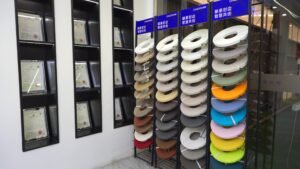

A PVC edge band can have the right color and the right thickness and still make finished furniture look unnatural. Surface embossing is usually the reason.
Embossing is more than a decorative step. It changes how PVC edge banding looks and feels, and it affects gloss, friction, and cleaning behavior. Buyers should evaluate embossing quality together with material formulation and production consistency, because a texture that looks convincing on a sample can disappear after a few thousand meters of production.
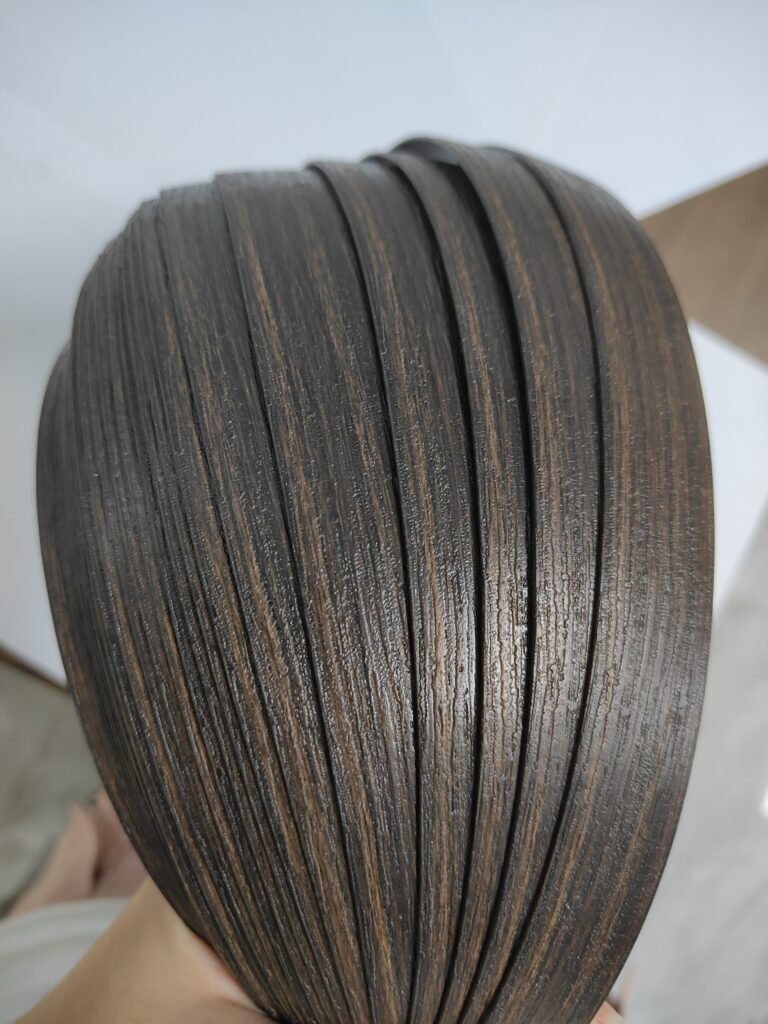
When I discuss PVC edge banding with furniture manufacturers and distributors, buyers pay close attention to color matching, thickness, width, and material quality. Surface embossing often gets less attention than it deserves.
A wood-grain edge band should not only be close in color to the decorative panel. Its surface should create a similar visual and tactile effect. Without that, the color can match and the furniture still looks different from the original design.
Two points are worth stating clearly at the start. A deeper texture does not automatically mean better quality, and a rougher surface does not automatically mean better scratch resistance. The embossing pattern has to fit the product design and the way the furniture will be used.
This article covers the main types of surface embossing, how each one affects performance, and what buyers should check before placing bulk orders.
Why Is Surface Embossing Important for PVC Edge Banding?
A flat PVC edge band rarely matches a decorative furniture panel. The color can be correct and the finished product still looks flat, because the panel has texture and the edge does not.
Embossing connects the visual design with the surface feel. It gives the banding a specific texture, changes how light reflects from it, and closes the gap between the edge and the panel.
How Does Surface Embossing Improve the Appearance of Furniture?
The main purpose of embossing is to make the edge banding look and feel like the material it is meant to match.
A wood-grain decorative panel has visible grain patterns and a defined surface texture. If the matching PVC edge banding is completely smooth and glossy, the difference is obvious at a glance, even when the color is close.
Embossing can produce several surface effects:
- Natural wood-grain texture.
- Fine matte texture.
- Deep wood-pore texture.
- Leather-like texture.
- Stone-like texture.
- Fine sand or fabric-like texture.
These patterns let manufacturers carry one appearance across the panel surface and its edges.
Why Is Texture Consistency Important for Furniture Manufacturers?
Edge banding should not be treated as an independent decorative material. It is part of the complete furniture design and it has to work with the panel, not compete with it.
When a manufacturer uses a natural oak panel, the edge banding should ideally share the grain direction, the texture depth, and the gloss level. If the banding is smooth while the panel has a deep open pore, the difference becomes obvious under side lighting, which is exactly how kitchen and wardrobe fronts are usually viewed.
This matters most for:
- Kitchen cabinet doors.
- Bedroom wardrobes.
- Office furniture.
- Decorative wall panels.
- Retail display furniture.
- High-end residential furniture.

Does Embossing Affect More Than Appearance?
Yes. Embossing changes the physical shape of the PVC surface.
A smooth surface and an embossed surface interact with light, objects, and cleaning materials in different ways. A textured surface scatters reflected light and reduces the appearance of strong reflections. A deeper texture also creates small spaces where dust and dirt can collect.
That does not mean embossing improves durability or scratch resistance by itself. Those properties depend on the PVC formulation, the surface condition, and the depth and shape of the texture.
| Embossing characteristic | Main effect | Furniture application |
|---|---|---|
| Fine wood grain | Creates a natural wood appearance | Wood-grain cabinets |
| Matte texture | Reduces strong visual reflections | Modern furniture |
| Deep wood pores | Adds a stronger tactile effect | Natural wood-look panels |
| Smooth finish | Creates a clean and simple appearance | Glossy or minimalist furniture |
| Leather texture | Creates a soft decorative appearance | Special furniture designs |
The starting point for selecting a pattern is the furniture design, not the texture catalogue. The best texture is rarely the most complex one. It is the one that produces the right visual and functional result for the application.
What Types of Surface Embossing Are Commonly Used in PVC Edge Banding?
Different furniture designs need different surface effects. Buyers who select PVC edge banding on color alone tend to overlook part of the matching process.
Each texture creates a different visual effect and places different demands on production and quality control.
1. Wood Grain Embossing
Wood-grain embossing is the most common surface treatment for decorative PVC edge banding.
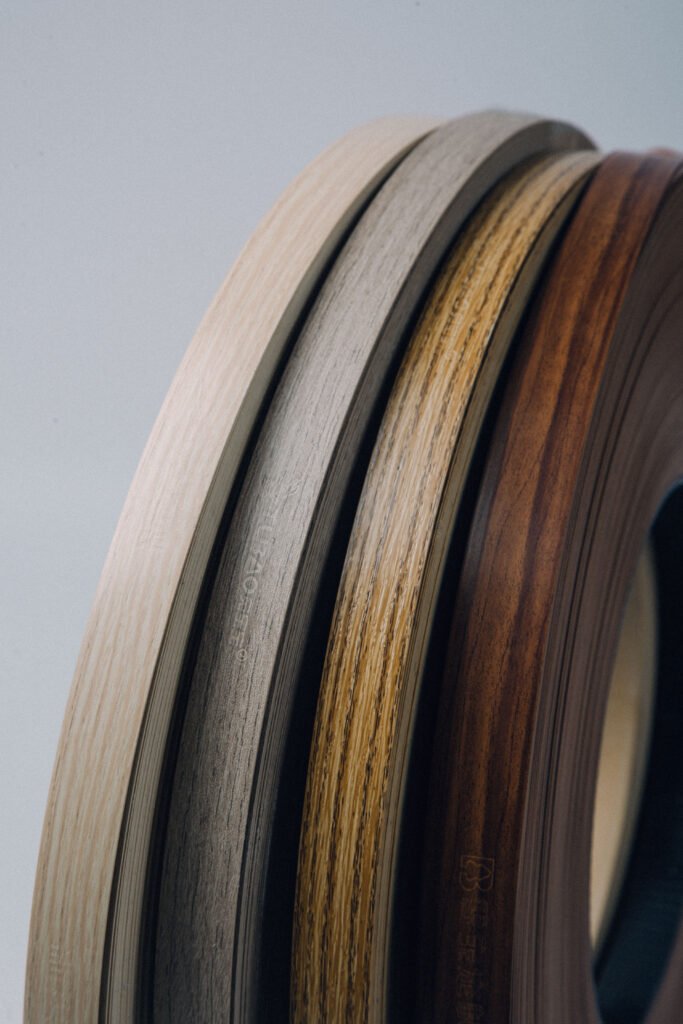
It reproduces a surface that looks and feels like natural wood, with fine grain lines, small pores, and irregular patterns. For manufacturers using wood-look panels, this is usually the default choice.
The general grain pattern is not enough on its own. Grain direction, depth, spacing, and visual detail also have to match the panel. A printed wood grain combined with an unrelated embossed texture looks artificial no matter how accurate the color is.
2. Matte Embossing
Matte embossing produces a surface with low visual reflection and a softer appearance.
It is common in modern furniture where strong reflections are unwanted. A matte surface can also make fingerprints and light surface marks less visible under certain lighting.
That does not make every matte product easier to clean. The result depends on texture depth, surface treatment, and material formulation. Compare matte samples under the same lighting before confirming a large order.
3. Deep-Pore Embossing
Deep-pore embossing creates more pronounced grooves and raised areas, and it is often used to reproduce natural wood more closely.
Compared with fine wood grain, deep-pore embossing gives a stronger tactile effect. The surface structure is clearly felt by hand.
Deeper is not automatically better. Deep grooves collect more dust and dirt and create more work during cleaning. Buyers should judge whether the texture suits the way the furniture will actually be used.
4. Leather and Other Special Textures
Some furniture designs use special textures instead of traditional wood grain. Leather-like embossing, fabric textures, stone patterns, and fine geometric patterns create different decorative effects.
These textures help manufacturers develop a particular visual style. Leather-like surfaces, for example, work well with panels designed to look soft and warm.
What matters is how the texture interacts with the printed color. A suitable pattern supports the design. A mismatched one makes the surface look artificial.
5. Synchronized Embossing
Synchronized embossing differs from ordinary embossing because the surface texture is aligned with the printed decorative pattern.
The raised and recessed areas of the wood grain are positioned to match the printed grain lines and pores, so what the eye sees and what the hand feels belong to the same pattern.
This requires much tighter control of both printing and embossing. If the printed pattern and the texture drift out of register, the effect collapses and the product looks worse than a simple non-synchronized texture.

Comparison of Common PVC Edge Banding Embossing Types
| Embossing type | Main visual effect | Tactile effect | Main consideration |
|---|---|---|---|
| Wood grain | Natural wood appearance | Fine or medium texture | Grain direction and matching |
| Matte | Low-reflection appearance | Usually subtle | Gloss consistency |
| Deep pore | Strong natural wood effect | Deep and noticeable | Cleaning and texture uniformity |
| Leather | Leather-like appearance | Soft or patterned feel | Decorative consistency |
| Synchronized | Visual and tactile alignment | Matches printed details | Registration accuracy |
| Fine sand texture | Subtle and uniform appearance | Fine roughness | Surface consistency |
These categories are not always separate. A PVC edge band can be matte and wood-grained at the same time, or synchronized and deep-pored. Manufacturers combine surface effects to meet a specific decorative requirement.
How Does Surface Embossing Affect the Durability and Performance of PVC Edge Banding?
Some buyers assume a rougher PVC edge banding surface resists scratches better. That is not a reliable way to judge quality.
Embossing changes the surface structure. It does not improve the mechanical properties of the PVC material underneath.
Texture, formulation, surface treatment, and application conditions should be evaluated together.
1. Does Embossing Improve Scratch Resistance?
This is one of the most common questions about embossed edge banding.
A textured surface can make minor scratches less noticeable, because the existing pattern reduces the visual contrast between the texture and a small mark. That is a visibility effect, not a resistance effect.
Scratch resistance depends on:
- PVC formulation.
- Surface hardness.
- Surface coating or treatment.
- Embossing geometry.
- Applied force and contact material.
- Testing conditions.
A deeply embossed product may hide small marks better than a smooth one. That does not prove it takes more force to scratch.
Two separate questions should be asked:
- Does the surface resist physical scratching?
- Does the texture make scratches less visible?
They are different characteristics, and one is not evidence of the other.
2. How Does Embossing Affect Cleaning and Dirt Accumulation?
Surface texture affects how easily a product can be cleaned.
A smooth PVC surface has fewer places for dirt to collect. An embossed surface has raised and recessed areas that can hold dust, grease, or other contaminants, depending on depth and shape.
This matters for furniture in kitchens, restaurants, and other environments where surfaces are cleaned regularly. A deep-pore wood-grain edge band can look more natural and still demand more attention during cleaning than a fine matte surface.
Deep textures are not automatically a problem. Ask the supplier for samples and run a practical cleaning test on the finished product.
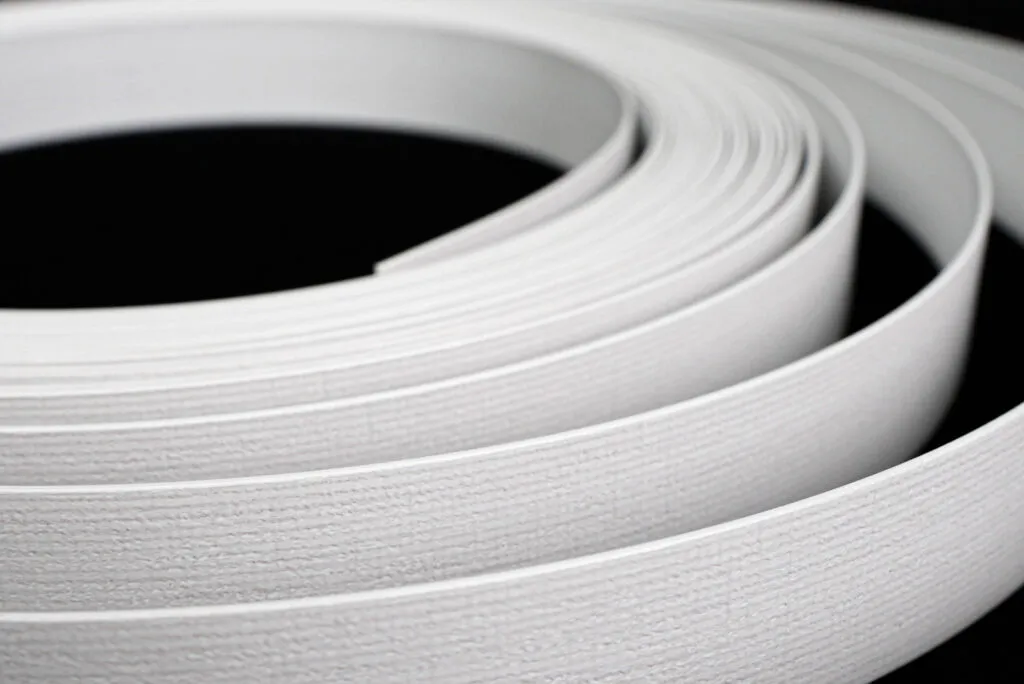
| Surface type | Cleaning consideration | Recommendation |
|---|---|---|
| Smooth | Fewer recessed areas | Suitable for easy-clean designs |
| Fine matte | Usually moderate cleaning requirements | Check stain removal |
| Fine wood grain | Small grooves may collect dirt | Test with normal cleaning methods |
| Deep pore | More recessed areas | Pay attention to grease and dust |
| Leather texture | Depends on pattern depth | Check cleaning consistency |
3. Does Embossing Affect Friction and Surface Contact?
Texture also changes how PVC edge banding contacts other materials.
Smooth and textured surfaces behave differently against hands, cleaning cloths, or objects. It would be wrong to claim that every embossed surface has higher friction. The result depends on texture geometry, material properties, contact pressure, and direction of movement.
A fine texture creates a different contact pattern from a deep-pore texture, and the behavior changes again when the surface is wet or contaminated.
For furniture manufacturers, this matters when selecting materials for surfaces that are touched often. Test the finished product rather than judging friction by appearance.
4. Can Embossing Affect Surface Wear Over Time?
Embossed surfaces change gradually during normal use.
Repeated cleaning, rubbing, and contact with objects affect the raised parts of the texture first. In some cases the raised areas show visible wear while the recessed areas still look new.
That is why the expected service environment should guide the choice of pattern. A bedroom wardrobe and a busy commercial counter do not place the same demands on a surface.
Surface wear should also be distinguished from material degradation. Embossing alone does not determine the overall durability of PVC edge banding.
5. Which Tests Should Buyers Consider?
Different performance requirements need different tests.
ASTM D1044 provides a method for evaluating abrasion resistance using the Taber Abraser. ASTM D4060 is another commonly referenced method, aimed at organic coatings.
Both should only be used when the test setup suits the actual PVC edge banding construction. A coating test is not a direct measurement of an uncoated PVC product.
Gloss measurement and practical cleaning tests are equally useful and much easier to arrange.
| Performance requirement | Suggested evaluation | What buyers should observe |
|---|---|---|
| Scratch resistance | Agreed scratch test | Scratch depth and visibility |
| Abrasion resistance | Suitable abrasion test | Surface wear |
| Cleaning performance | Standardized cleaning procedure | Remaining dirt and stains |
| Friction | Suitable friction test | Change in surface contact |
| Gloss consistency | Gloss measurement | Differences between samples |
| Texture durability | Repeated rubbing or wear test | Loss of surface definition |
A good manufacturer can explain which properties have been tested and which have not. General claims such as “deep embossing means better wear resistance” should not be accepted without test results behind them.

Have a spec or project to discuss?
Send your panel, thickness, finish and volume. Our engineers reply with a matched color, sample plan and price — usually within 24 hours.
Request a Quote1,000+ stock colors · Swatches on request
How Does Surface Embossing Influence the Appearance and Color Matching of PVC Edge Banding?
Color matching is one of the most important requirements when furniture manufacturers buy PVC edge banding. Matching the color alone is not enough.
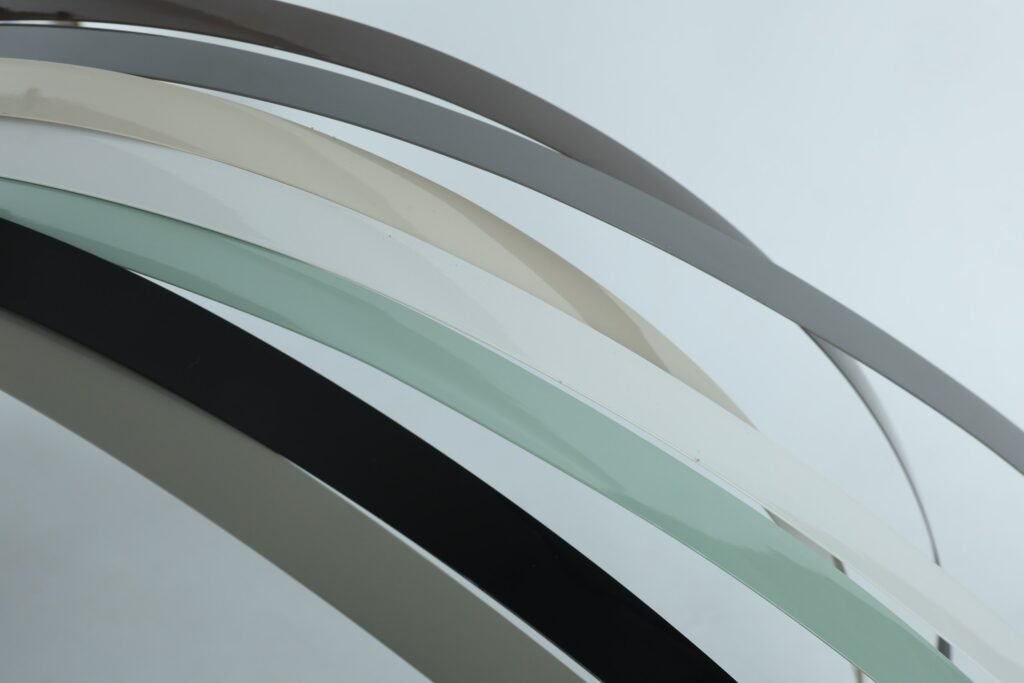
Two products can have almost identical colors and still look different, because their texture and gloss are not the same. Color, embossing, and surface appearance have to be evaluated together.
1. How Does Surface Texture Change Color Perception?
Embossing changes how people perceive the color of PVC edge banding, and the reason is light reflection.
A smooth surface reflects light in a more regular direction. An embossed surface has raised and recessed areas, so light scatters. That changes the apparent brightness and the visual depth of the material.
A dark oak PVC edge band with a deep wood-grain texture can look darker in some lighting because the recessed areas create shadows. The same color with a smooth surface looks brighter.
A color sample should always be evaluated together with its actual surface texture.
2. Why Should Buyers Match Gloss Levels?
Gloss is the other half of decorative consistency.
A high-gloss panel paired with a low-gloss edge band creates a visible difference even when both use the same color. The reverse is equally true.
Check gloss levels when selecting PVC edge banding, especially for products with large visible surfaces.
ASTM D2457 provides a method for measuring the specular gloss of plastic films and solid plastics, covering measurement angles including 20°, 45°, 60°, and 85°.
Gloss measurement has limits on textured surfaces. ISO 2813:2014 is written for non-textured coatings on flat, opaque substrates, and its scope does not directly cover every embossed surface.
For embossed PVC edge banding, use gloss readings as comparative information and combine them with visual inspection under controlled lighting.
3. Why Is Synchronized Texture Important for Color Matching?
Synchronized embossing is especially valuable when the furniture needs a realistic wood appearance.
Printing creates a visual pattern. Embossing creates a physical one. When the two do not match, the product looks wrong even at a distance.
A printed knot may sit in one position while the embossed grain line rises somewhere else. That mismatch reduces the quality of the decorative effect, and it is much easier to notice on a large cabinet door than on a small sample.
Synchronized embossing solves this by aligning the physical texture with the printed design. Buyers should still inspect actual samples, because not every product described as synchronized holds accurate registration across a full roll.
4. What Should Buyers Check When Comparing Colors and Textures?
At minimum, four things:
- Color consistency under the same lighting conditions.
- Gloss level compared with the decorative panel.
- Texture pattern and direction.
- Alignment between printed patterns and embossed details.
Viewing distance matters as well. A small difference is hard to see on a narrow edge and becomes obvious when several cabinet doors are installed side by side.
| Evaluation item | What to check | Possible problem |
|---|---|---|
| Color | Compare under consistent lighting | Color mismatch |
| Gloss | Compare reflected light | Different surface brightness |
| Texture depth | Check the raised and recessed areas | Unnatural appearance |
| Grain direction | Compare with the decorative panel | Visual inconsistency |
| Pattern registration | Check printed and embossed alignment | Misaligned wood grain |
| Batch consistency | Compare samples from different batches | Uneven finished furniture appearance |
5. Why Should Buyers Approve Both Physical and Visual Samples?
A digital image or a printed color reference is not enough to approve a product.
A screen cannot represent surface detail accurately. Brightness, camera settings, and lighting all change how a product appears. Physical samples are the only reliable reference.
Compare the PVC edge banding directly with the actual decorative panel whenever possible. For important projects, keep an approved reference sample and use it to check future production batches. This reduces disputes when the same color and embossing pattern are reordered months later.
How Should Buyers Evaluate Surface Embossing Quality When Sourcing PVC Edge Banding?
This is the part that matters most for distributors and furniture manufacturers.
A supplier may offer dozens of embossing patterns, and the size of the catalogue says nothing about production capability. What counts is surface quality, consistency, and the ability to reproduce the approved sample.
1. Check Embossing Depth and Uniformity
Start with consistency across the full width of the roll.
A good embossed product has a clear and stable pattern. Look for:
- Consistent texture depth.
- Clear grain details.
- No unexpected flat areas.
- No irregular raised marks.
- No visible surface defects.
- Consistent texture from the start of the roll to the end.
Uneven embossing shows up in the finished furniture. If one section has a deep texture and another looks almost smooth, the difference will be visible once the panels are installed.
Compare samples from different production runs to see whether the manufacturer can hold the same effect over time.
2. Check Whether the Embossing Pattern Matches the Intended Application
Not every texture suits every design.
Choose the pattern from the decorative panel rather than from the most popular option in the catalogue:
- Natural oak panels usually need wood-grain embossing.
- Modern minimalist panels work better with fine matte textures.
- Deep wood-look panels need deep-pore embossing.
- Special decorative furniture may use leather-like or stone-like textures.
Check the embossing direction against the panel design as well. This becomes critical on large cabinet doors and panels where the grain direction is clearly visible.
3. Evaluate the Surface Under Different Lighting Conditions
Never judge embossed PVC edge banding under a single lighting condition.
Light direction changes how texture appears. A pattern can look sharp under direct light and almost disappear under soft light. Some surface defects only show when light comes from the side.
Inspect samples under:
- Normal indoor lighting.
- Direct lighting.
- Side lighting.
- Different viewing angles.
This shows how the product will actually look in a finished room.
4. Ask for Relevant Quality Test Results
Request test reports that match the real performance requirements.
| Quality requirement | Suggested inspection method | Purpose |
|---|---|---|
| Embossing uniformity | Visual and dimensional comparison | Check texture consistency |
| Gloss level | Suitable gloss measurement | Compare surface appearance |
| Scratch resistance | Agreed scratch test | Evaluate resistance to surface damage |
| Abrasion resistance | Suitable abrasion test | Evaluate wear performance |
| Cleaning performance | Controlled cleaning test | Check dirt and stain removal |
| Color matching | Spectrophotometer and visual comparison | Check decorative consistency |
| Batch consistency | Compare approved and production samples | Maintain repeat-order quality |
Not every test is mandatory for every order. The testing plan should follow the product application, the customer requirement, and the quality agreement with the supplier. A standard wardrobe band does not need the same program as a high-end commercial furniture product.
5. Confirm Embossing Quality Before Mass Production
Sample approval is the step that prevents most disputes.
Buyer and supplier should agree on:
- PVC edge banding color.
- Product thickness and width.
- Embossing pattern.
- Surface gloss level.
- Texture depth and direction.
- Reference decorative panel.
- Approved sample identification.
Keep a signed or clearly identified reference sample, and put the sample approval criteria in writing so that reorders are checked against the same standard. “Natural oak wood grain” is not a production specification, and two manufacturers will interpret the same description differently. A physical sample gives both sides something concrete to measure against.

6. Evaluate the Manufacturer’s Production Capabilities
Embossing quality depends on more than the design of the embossing roller.
The manufacturer also has to control processing conditions and keep production stable. The important factors are:
- Embossing roller quality.
- Temperature control.
- Pressure control.
- Production speed.
- Material thickness consistency.
- Pattern registration.
- Inspection during production.
For manufacturers running large volumes of PVC edge banding, these controls separate a consistent supplier from one that produces a good first sample.
Ask whether the supplier can reproduce the same embossing pattern for repeat orders. A factory that delivers one perfect sample and then drifts during mass production creates a specific problem for distributors: the complaint arrives from the end customer, not from the factory.
- Color Matching Workflow in PVC Edgeband Factories →
- Matte Finish vs Glossy PVC Edge Banding: Which Is Better for OEM Furniture Projects? →
- PVC Edge Banding Colors: How to Match Edge Banding with Different Woodgrain Panels →
- How to Match PVC Edge Banding with Egger, Kronospan, and Other Decorative Boards →
Match the Panel, Not Just the Color
Send a board sample and we match color, gloss and surface texture, including embossed and synchronized finishes.
See Color Matching Service
Conclusion
Good surface embossing balances appearance, texture consistency, and practical performance. Buyers should approve physical samples, check texture under more than one lighting condition, and verify production quality before bulk purchasing.
References and Data Sources
- ASTM International – ASTM D2457: Standard Test Method for Specular Gloss of Plastic Films and Solid Plastics
https://store.astm.org/standards/d2457
Explains how gloss is measured on plastic films and solid plastics at different angles, and discusses the relationship between surface smoothness and gloss. - ISO – ISO 2813:2014: Paints and Varnishes – Determination of Gloss Value at 20°, 60° and 85°
https://www.iso.org/standard/56807.html
Provides an internationally recognized method for measuring gloss. Its scope covers non-textured coatings on flat, opaque substrates, which buyers should keep in mind when evaluating embossed PVC surfaces. - ASTM International – ASTM D4060-25: Standard Test Method for Abrasion Resistance of Organic Coatings by the Taber Abraser
https://store.astm.org/standards/d4060
Describes a method for evaluating the abrasion resistance of organic coatings. Its applicability should be checked carefully before it is used to assess PVC edge banding. - ASTM International – ASTM D1044-24: Standard Test Method for Resistance of Transparent Plastics to Surface Abrasion by the Taber Abraser
https://store.astm.org/d1044-24.html
Provides a method for evaluating surface abrasion on transparent plastics through changes in optical properties. Useful as a reference for understanding abrasion testing, but not a universal method for opaque embossed PVC edge banding. - European Patent Office – EP 0569640 A1: Chemically-Embossed Polyvinyl Chloride Film
https://patents.google.com/patent/EP0569640A1/en
Describes conventional mechanical embossing of PVC using patterned rollers, controlled heating, pressure, and cooling. It provides technical background on how surface patterns are created in PVC products. - EGGER – Processing Instructions: PVC Edge Banding
https://www.egger.com/get_download/6afd90c9-61aa-4e87-9747-957c0522897a/Processing_instruction_EGGER_Edging_PVC.pdf
Practical information on PVC edge banding construction, applications, adhesion promoters, and processing operations in furniture manufacturing.
Technical note: No single universal test standard defines the overall quality of embossed PVC edge banding. Buyers should combine visual inspection, physical sample comparison, and application-specific performance tests.