

I have seen how a wide product range can attract buyers, but it can also tie up cash in slow-moving stock. The real challenge is choosing products that sell and make money.
I believe distributors can build a profitable edge banding product portfolio by focusing on customer demand, selecting the right materials and colors, balancing standard and custom products, and managing inventory based on sales data. A reliable manufacturer can also help reduce supply risks and support long-term growth.

I would not measure a product portfolio by the number of SKUs alone. I would look at how well each product serves a real customer need, how often it sells, and how much profit it brings. I would also consider how each product affects storage, cash flow, and repeat orders. These factors help me build a product range that supports both sales and long-term business growth.
Why Does Product Portfolio Planning Matter for Edge Banding Distributors?
I believe product portfolio planning is important because a distributor can lose money even when sales look strong. Too few products may cause missed orders, while too many products may increase storage costs and leave cash tied up in stock.
I plan a portfolio around customer needs, sales potential, and the total cost of holding each product. This helps me make better purchasing decisions and build a more stable business.

How Does Product Selection Affect Profitability?
I do not judge a product only by its selling price or gross margin. I also look at how quickly it sells and how much money I need to keep it available.
For example, a special wood grain edge banding product may offer a higher margin than a standard white product. However, if customers order it only a few times a year, I may need to hold stock for months. A standard color may bring a smaller margin per meter, but regular orders may make it more valuable to my business.
I use several measures to compare products:
- Sales volume: How many meters or rolls do customers buy over a given period?
- Gross margin: How much money remains after I deduct the product cost from the selling price?
- Inventory turnover: How quickly does the stock sell and need to be replaced?
- Repeat purchase rate: How often do customers reorder the same product?
- Service value: Does the product help me win or retain other orders?
I also consider the cost of a stockout. If a customer needs a matching edge banding product to complete a furniture order, an unavailable item may put the whole order at risk. I may lose more than one product sale.
How Can I Identify the Right Portfolio Size?
I do not believe that every distributor needs the same number of SKUs. A regional wholesaler serving small cabinet shops may need a different range from a supplier serving large furniture manufacturers.
I start with actual order history and customer conversations. I group products by material, color, thickness, width, and finish. Then I identify the products that customers buy regularly and the products they request but cannot easily find.
I also separate products that support daily sales from products that help me win special orders. This approach keeps my portfolio focused without making it too narrow.
| Business measure | What I check | How it helps |
|---|---|---|
| Sales frequency | Orders per month or quarter | Identifies regular sellers |
| Gross margin | Selling price minus product cost | Shows basic product profitability |
| Stock turnover | Sales compared with average inventory | Highlights slow-moving stock |
| Customer demand | Requests, quotations, and lost orders | Reveals product gaps |
| Supplier lead time | Time from order to delivery | Helps set stock levels |
I would review these measures at least once every quarter. I would also check them after a major customer changes its product range or after a new furniture trend creates demand for different colors and finishes.
Which Edge Banding Products Should Distributors Prioritize?
I do not think distributors should stock every available material, color, and size. A large product range looks attractive, but it does not always match what customers need. I would start with products that solve common problems and add special products when I see clear demand.
I would prioritize products based on customer orders, local furniture styles, production needs, and the cost of keeping stock. I would also check whether my supplier can provide consistent quality across repeat orders.
Which Product Categories Should I Include?
I would divide my product range into three groups. Each group would have a different role in my business.
Core products
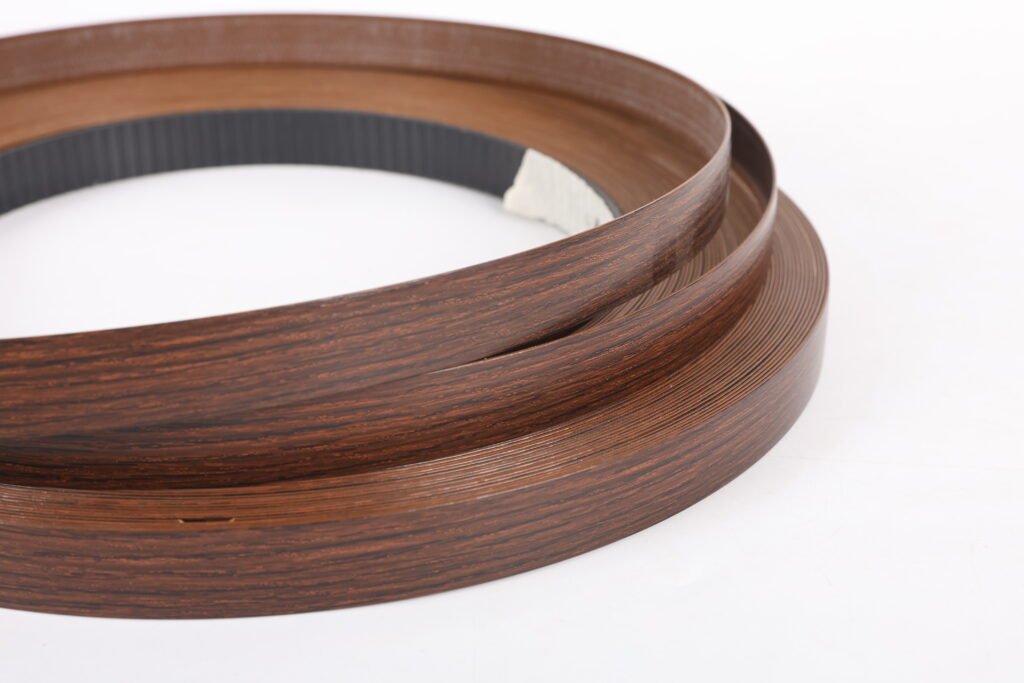
I would begin with common colors, popular wood grain patterns, and specifications that fit the needs of my main customers. Depending on the market, these may include white, black, gray, oak, and walnut designs. I would confirm demand before deciding which colors deserve regular stock.
I would also focus on the thicknesses and widths that my customers use most often. A distributor serving cabinet manufacturers may need a different mix from one serving custom furniture workshops.
Growth products
I would add products that help me reach new customer groups or meet changing design needs. These may include matte finishes, high-gloss finishes, special textures, and additional materials such as ABS or acrylic edge banding.
I would not add these products just because they look different. I would first ask customers about their current projects and check whether they are willing to pay for the extra features.
Special-order products
I would keep less common colors, unusual specifications, and highly customized products in a separate group. I could offer these products without keeping large quantities in my warehouse. This approach would help me provide more choices while limiting the risk of unsold inventory.
How Should I Compare Different Product Options?
I would use a simple scoring system to compare new products before I place an order. The scores below are an example of my own decision-making method, not industry-wide benchmarks.
| Selection factor | Weight | My main question |
|---|---|---|
| Customer demand | 30% | Do customers order it regularly? |
| Profit potential | 25% | Can I earn a suitable margin? |
| Repeat orders | 20% | Are customers likely to buy it again? |
| Supply reliability | 15% | Can my supplier maintain consistent quality and delivery? |
| Product differentiation | 10% | Does it help me stand out from competitors? |
I would score each factor from 1 to 5 and calculate a weighted total. I would then compare the result with the actual cost and risk of stocking the product.
For example, a popular wood grain color with stable supply may deserve regular stock. A special finish with uncertain demand may be better as a sample-led or order-based product. I would also review customer feedback and competitor offerings before making the final decision.
How Can Distributors Balance Standard Products and Custom Options?
I believe standard products and custom options serve different purposes. Standard products help me fulfill regular orders quickly, while custom products help me meet specific design needs and compete for orders that standard ranges cannot cover.
I would not choose one approach for the entire business. I would use standard products as the foundation and add customization when customer demand, order size, and production conditions make it practical.

When Should I Choose Standard Products?
I would choose standard products when customers need common colors, repeatable specifications, and short delivery times. These products are easier to plan because I can use past sales to estimate demand.
Standard products can also simplify purchasing. If several customers use the same color and specification, I can combine their demand and order more efficiently. This may help me negotiate better prices and reduce the risk of holding many small quantities.
However, I would not assume that a standard product is always the cheapest option. I would compare the purchase price, shipping cost, minimum order quantity, storage needs, and expected sales. A low unit price may not be attractive if the product sells slowly.
When Does Customization Make Sense?
I would consider custom products when customers need a closer color match, a special surface finish, a specific size, or a product that is not available in the standard range.
Before accepting a custom order, I would confirm several details with the customer and manufacturer:
- The panel brand, color code, texture, and finish that the edge banding needs to match.
- The required material, thickness, width, and surface properties.
- The minimum order quantity and the price at that quantity.
- The sample approval process and the expected production lead time.
- The process for handling repeat orders and maintaining color consistency.
I would also ask whether the customer expects to reorder the same design. A custom product may be a good long-term opportunity if a furniture manufacturer uses it across many projects. It may be a poor inventory choice if the customer needs it for only one small job.
How Can I Decide Between Standard and Custom Products?
I would compare both options using the same cost and demand information.
| Factor | Standard products | Custom products |
|---|---|---|
| Main advantage | Easier to stock and replenish | More specific customer fit |
| Typical risk | Strong price competition | Uncertain demand and higher order requirements |
| Inventory approach | Stock based on sales history | Use samples and confirmed orders where possible |
| Best use | Regular, repeat demand | Clear project needs or repeatable special demand |
| Key supplier question | Can quality and supply stay consistent? | Can specifications and color be repeated accurately? |
I would also test custom demand before adding a product to regular inventory. I could collect sample requests, ask for project forecasts, or secure a confirmed order. After several repeat orders, I would review whether the product deserves a permanent place in my range.
This method allows me to offer customers more choices without making every special request an inventory commitment.
How Can Distributors Optimize Inventory and Profit Margins?
I do not see inventory management as a simple task of keeping enough products in stock. I see it as a way to protect cash flow while making sure customers can get the products they need.
I would use sales history, supplier lead times, order frequency, and total product costs to set inventory levels. I would also review actual profit instead of relying on the difference between the purchase price and selling price alone.

How Can I Identify Products That Need More or Less Stock?
I would start by reviewing sales by SKU over the last 6 to 12 months. I would compare sales volume, order frequency, current stock, and the time needed to replenish each product.
I would then group products into three categories.
- High-priority products: These products sell regularly and have a clear role in meeting customer demand. I would monitor their stock more closely.
- Medium-priority products: These products sell less often but still support important customers. I would keep moderate stock or replenish them when demand becomes clearer.
- Low-priority products: These products have limited demand or long periods without sales. I would consider reducing stock, selling existing inventory, or switching to order-based purchasing.
I would not use sales volume as the only measure. A low-volume product may still be important if a key customer depends on it. I would also check whether seasonal demand, a recent project, or a temporary supply problem has affected the numbers.
The U.S. Census Bureau tracks business inventory and sales across retail, wholesale, and manufacturing sectors. Its data show why inventory and sales are useful measures of business activity. However, broad U.S. inventory data cannot tell me exactly how much PVC or ABS edge banding a particular distributor should stock. I would use industry-level data for context and my own order history for purchasing decisions.
How Can I Calculate the Real Profit of a Product?
I would calculate gross margin first, but I would not stop there.
For example, suppose I buy a product for $70 and sell it for $100. My gross profit is $30, and my gross margin is 30%.
However, I may also pay for freight, import duties, local delivery, packaging, storage, and order handling. If those costs total $15 per unit, only $15 remains before other operating expenses. This example is for illustration, not a market price estimate.
I would use the following formulas:
\[ \text{Gross Margin}=\frac{\text{Sales}-\text{Product Cost}}{\text{Sales}}\times100\% \]
\[ \text{Contribution}=\text{Sales}-\text{Product Cost}-\text{Variable Costs} \]
I would also track how much inventory I need to support each product. A product with a high margin may still be a poor choice if it sells slowly and ties up too much cash.
Which Inventory Measures Should I Track?
| Measure | Calculation or method | What it tells me |
|---|---|---|
| Gross margin | Gross profit ÷ sales | The share of sales remaining after product cost |
| Inventory turnover | Cost of goods sold ÷ average inventory value | How quickly inventory moves |
| Days of inventory | Average inventory value ÷ cost of goods sold × days in period | How long stock may remain on hand |
| Stockout frequency | Number of stockout events over a period | Whether stock levels are meeting demand |
| Slow-moving stock | Products with little or no sales over a defined period | Where cash may be tied up |
I would review these measures every month and look for changes rather than relying on a single result. I would also set different stock rules for fast-moving standard colors and low-demand custom products. This gives me a clearer way to protect margins without sacrificing customer service.
How Can Manufacturers Help Distributors Build a Competitive Product Portfolio?
I believe a profitable portfolio depends on more than the distributor’s own purchasing decisions. The manufacturer also affects product quality, delivery times, product development, and the ability to respond to customer requests.
I would choose a manufacturing partner based on how well it supports my business over time. A low quoted price is useful, but it does not solve problems caused by inconsistent colors, delayed orders, or unclear product specifications.

What Should I Expect from a Manufacturer?
I would expect a manufacturer to provide clear product specifications, stable quality, and practical support with samples and repeat orders.
For example, if I sell edge banding to furniture manufacturers, I need more than a list of available colors. I need to know the material, thickness, width, finish, and other relevant specifications. I also need a clear process for checking color matches and approving samples before larger orders.
I would ask potential suppliers these questions:
- Can the manufacturer provide samples for color and texture approval?
- Can it maintain consistent specifications across repeat orders?
- What are the minimum order quantities for standard and custom products?
- How long do sampling, production, and delivery usually take?
- Can it provide product data, packaging details, and quality records?
- How does it handle quality complaints and replacement requests?
I would compare suppliers using the same questions. This helps me avoid choosing a manufacturer based only on a low initial quote.
How Can Supplier Support Help Me Expand My Range?
I would look for manufacturers that can help me test new products before I commit to large orders. Sample support is especially useful when I want to explore a new color, surface finish, or material.
I would also discuss demand forecasts with the manufacturer. If I can share expected order volumes and product priorities, the manufacturer may be better able to plan production and recommend suitable order quantities. Any agreed lead times and stock arrangements should be confirmed clearly.
I would not assume that a manufacturer can provide every product or guarantee every delivery date. I would verify its actual capabilities, production capacity, quality controls, and terms before making promises to customers.
How Should I Compare Manufacturing Partners?
| Evaluation factor | What I would verify | Why it matters |
|---|---|---|
| Product range | Available materials, colors, sizes, and finishes | Helps me cover customer needs |
| Quality control | Inspection process and specification records | Reduces quality-related disputes |
| Supply reliability | Actual lead times and delivery history | Supports inventory planning |
| Customization | Sample process, minimum quantities, and repeat-order controls | Makes special products easier to manage |
| Total cost | Product price, freight, packaging, and other charges | Helps me compare the real cost |
| Communication | Response time and complaint handling | Helps resolve problems before they affect customers |
I would also review supplier performance after orders are delivered. I would track on-time delivery, product defects, specification accuracy, and the handling of complaints. I would use these results when deciding which supplier should support my core products and which suppliers may be suitable for special orders.
A strong manufacturer relationship should help me serve customers more consistently. It should also help me expand my product range based on real demand, rather than adding products without a clear sales plan.
Conclusion
I build a profitable edge banding portfolio by matching products to customer demand, balancing standard and custom options, tracking inventory costs, and working with manufacturers that support consistent quality and reliable supply.
Data Sources and References
I use the following sources to support my inventory planning and product portfolio decisions. The recommendations in this article are practical business guidance, not claims that a single product mix works for every distributor.
1. U.S. Census Bureau — Manufacturing and Trade Inventories and Sales https://www.census.gov/mtis/index.html Provides data on inventory and sales activity across U.S. retail, wholesale, and manufacturing sectors.
2. U.S. Census Bureau — Inventories https://www.census.gov/topics/business-economy/inventories.html Provides access to inventory statistics and related economic data.
3. U.S. Census Bureau — Annual Integrated Economic Survey https://www.census.gov/programs-surveys/arts.html Explains the survey program that collects business data, including sales, inventory, purchases, and operating expenses.