A PVC edge band can pass factory inspection and still fail on a furniture production line when the material, machine, adhesive, and working conditions do not match.
Quality inspection usually checks whether the PVC edge band meets defined material standards. Production checks whether the whole system can produce a stable result. A qualified edge band can still show poor bonding, edge lifting, color change, or finishing problems when production conditions are different.
When I look at an edge banding problem, I do not only ask whether the edge band passed inspection. I also look at what happens between the supplier’s factory and the customer’s production line. This difference often explains why the same PVC edge band works well in one factory but causes problems in another.
Why Can PVC Edge Banding Pass Factory Quality Inspection but Fail During Furniture Production?
A factory inspection can confirm that PVC edge banding meets its defined specifications. However, production performance also depends on the board, adhesive, machine, temperature, speed, pressure, and finishing process.
I often see this problem when people treat the inspection report as a complete guarantee of production performance. In reality, the report and the production trial answer two different questions.
What Does a Factory Quality Inspection Actually Check?
A supplier normally checks specific properties according to an internal or agreed specification. These properties can include thickness, width, appearance, color, gloss, and other physical or processing-related requirements.
For example, REHAU publishes standard tolerances for PVC and ABS edgebands. Its technical information also describes regular quality checks and defined production tolerances. This shows an important point: quality control needs measurable standards.
However, a measurement is only one part of the production result.
| Factory inspection may check | Furniture production may add |
|---|---|
| Thickness | Board thickness and edge condition |
| Width | Actual machine adjustment |
| Color | Panel color and lighting |
| Surface appearance | Scraping and polishing |
| Dimensional tolerance | Feed and pressure conditions |
| Adhesion-related properties | Actual adhesive and machine settings |
| Material consistency | Production speed and temperature |
I therefore separate material quality from application performance.
A PVC edge band can meet its thickness tolerance but still be difficult to process if the machine is not adjusted correctly. A surface can pass visual inspection but look different after scraping or buffing. An edge band can also have suitable bonding properties but perform poorly when the adhesive temperature or application amount is wrong.
REHAU’s PVC technical information makes this relationship clear. It states that high-quality and durable application depends on the edge band, glue, boards, edgebander, and ambient temperature. It also recommends processing trials to identify suitable conditions.
Why Is the Production Trial So Important?
I see a production trial as the bridge between laboratory quality and real production.
A supplier can test the edge band under controlled conditions. A furniture factory has a different environment. The factory may use another board, another adhesive, another machine, another feed speed, and another temperature.
This is why I would not use a simple statement such as “The product passed inspection, so the production problem cannot be the edge band.”
That conclusion is too simple.
The better question is:
Did the edge band pass the inspection, and was the same application system tested under real production conditions?
That question gives both the supplier and furniture manufacturer a better starting point.
How Can Furniture Panel, Adhesive, and Machine Settings Affect PVC Edge Banding Performance?
PVC edge banding does not work alone. I always look at the complete combination of PVC edge band + panel + adhesive + machine before judging the material.

A good edge band can perform differently when one part of this combination changes. This is especially important when a furniture manufacturer changes suppliers but keeps the same production settings.
The Panel Can Change the Result
The board surface directly affects bonding.
The edge of the panel needs to provide a suitable surface for adhesive application. Dust, poor milling, uneven edges, or unsuitable board conditions can reduce the quality of the final bond.
This means I would not only inspect the PVC strip when a bonding problem appears. I would also inspect the panel edge before the glue is applied.
The Adhesive Must Match the Application
Different adhesives have different processing requirements.
REHAU notes that PVC edgebands can be processed with hot-melt adhesives and that the suitable conditions depend on the components used. Its technical information also points out that adhesive processing temperature varies by adhesive type.
The basic relationship can be viewed like this:
| Variable | Possible production effect |
|---|---|
| Adhesive type | Changes bonding behavior |
| Glue temperature | Changes adhesive flow and bonding |
| Glue amount | Changes coverage and joint quality |
| Panel surface | Changes contact with adhesive |
| PVC surface | Changes adhesion |
| Machine pressure | Changes contact between materials |
For this reason, I do not recommend changing only the PVC edge band and keeping every machine parameter unchanged. A new material can require a new processing trial.
The Machine Also Becomes Part of the Quality System
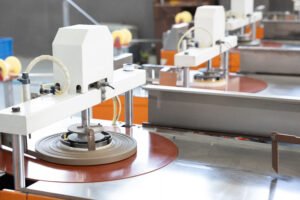
Modern edge banding machines control several stages of the process. HOMAG machines, for example, use systems for glue application, pressure, trimming, scraping, and finishing. Feed speed and machine configuration also vary between models.
So when I compare two factories, I do not assume that the same PVC edge band should behave exactly the same way.
The machine may have a different glue system. The pressure may be different. The feed speed may be different. The finishing tools may also be different.
This is why “same PVC edge band” does not always mean “same production result.”
Why Can Temperature, Feed Speed, and Pressure Cause Problems During Edge Banding?
Temperature, feed speed, and pressure control how much time and force the PVC edge band has to bond with the panel. Small changes in these conditions can create visible production problems.
I pay special attention to these three factors because they can change during production without anyone immediately noticing.
Temperature Controls the Working Window
Temperature affects adhesive behavior.
REHAU’s current PVC technical information states that boards and edgebands should be processed above 18°C because lower temperatures can cause the adhesive to set too quickly. It also warns that actual applicator roller temperature can vary significantly from the thermostat setting.
This creates an important production risk.
The machine display may show the expected temperature, but the actual application area may not have exactly the same temperature.
I therefore would not check only the machine display when troubleshooting bonding.
Feed Speed Changes the Process
Feed speed affects the time available for adhesive application and pressure.
A faster production line can increase output, but it also changes the relationship between adhesive amount, pressure, heating, and contact time.
HOMAG publishes different feed-speed ranges for different edge banding machines. For example, its EDGETEQ S-356 lists a feed speed of 16–25 m/min, while other machine configurations use different ranges.
This does not mean one speed is correct for every PVC edge band.
It means I need to match the material and processing conditions instead of treating speed as an isolated number.
Pressure Helps Create Stable Contact
Pressure rollers help keep the edge band in contact with the panel while the adhesive sets.
If pressure is too low, the contact may not be stable. If the machine alignment is poor, the pressure may not be distributed evenly.
| Production factor | What I would check |
|---|---|
| Temperature | Actual adhesive and working temperature |
| Feed speed | Whether speed matches the process |
| Pressure | Roller contact and alignment |
| Glue amount | Whether coverage is stable |
| Panel surface | Milling quality and cleanliness |
| PVC edge band | Thickness, width, surface, and batch |
When I troubleshoot a production failure, I therefore avoid changing five parameters at once.
I prefer to record the current settings, change one important variable, run a controlled trial, and compare the result.
That approach makes the problem easier to identify.
How Can Batch Variation and Storage Conditions Affect PVC Edge Banding Quality?
Even when two PVC edge bands have the same product specification, batch differences and poor storage can affect how the material performs during production.

I think this part is often ignored because buyers usually focus on the inspection report. However, production happens after the material has left the supplier’s factory.
Batch Variation Does Not Always Mean a Failed Product
A small difference between production batches does not automatically mean that one batch is defective.
For example, REHAU’s technical information notes that slight lot-to-lot color variation can occur and that visual inspection is performed under controlled lighting conditions.
This matters when a furniture manufacturer needs strict color consistency.
The buyer may compare a new roll directly with an older roll under different lighting. The factory may then believe the new material has a serious color problem even when both materials remain within their defined specifications.
This is why I recommend keeping a retained sample or approved master sample for important projects.
Storage Can Change the Processing Condition
PVC edge banding is not normally stored in the same controlled environment as a supplier’s laboratory.
It may travel by truck, container, warehouse, or distributor before reaching the production line.
REHAU recommends storing its PVC edgebands at around 18–25°C in a dry and clean environment, protected from light and solvent vapors. It also recommends a processing trial before series production when material has been stored for more than 12 months.
That gives me a simple rule:
Do not look only at production date. Look at storage history too.
What Should I Record for Each Batch?
For repeated orders, I would keep basic batch information.
| Information | Why it matters |
|---|---|
| Batch number | Helps trace problems |
| Production date | Helps identify material age |
| Color code | Prevents color mix-ups |
| Thickness | Helps control processing |
| Width | Helps control trimming |
| Approved sample | Gives a visual reference |
| Storage condition | Helps explain later problems |
| Production trial result | Links material to real use |
This information becomes especially useful when a customer reports that “the previous batch worked, but this batch does not.”
Instead of guessing, I can compare the records.
That is much more useful for both the supplier and the furniture manufacturer.
How Can Furniture Manufacturers Prevent PVC Edge Banding Failures During Production?
I can reduce most avoidable problems by treating PVC edge banding as a complete production system instead of judging the material by inspection results alone.
The goal is not to make the production process more complicated. The goal is to make problems easier to find before they affect a large order.
Start With a Real Production Trial
Before mass production, I recommend testing the actual combination of:
- PVC edge band
- furniture panel
- adhesive
- edge banding machine
- processing speed
- temperature
- pressure
- finishing tools
The trial should use the same or similar conditions as the final production.
A laboratory test can confirm material properties. A production trial can confirm application performance.
I need both when the application is important.
Create a Processing Parameter Record
I would also record the machine settings that produce an acceptable result.
| Parameter | Record |
|---|---|
| PVC edge band specification | Thickness, width, color, batch |
| Panel specification | Board type and thickness |
| Adhesive | Type and grade |
| Adhesive temperature | Actual operating value |
| Glue amount | Machine setting or measured amount |
| Feed speed | Production setting |
| Pressure | Machine setting |
| Finishing | Trimming, scraping, buffing |
| Inspection result | Appearance and bonding |
This record gives the production team a reference when the material or machine changes.
Inspect During Production, Not Only Before Production
I do not think final inspection is enough.
A production line can start correctly and then change after several hours. Tools can wear. Temperature can move. Glue conditions can change. Dust can build up. Operators can adjust settings.
So I prefer three levels of control:
Incoming inspection → Production trial → In-process inspection
This approach also makes communication with the supplier easier.
If a problem appears, the furniture manufacturer can provide actual batch information, machine settings, photos, panel information, and production conditions.
The supplier can then investigate the material instead of receiving only a statement such as “the edge band is not working.”
Ask the Supplier Better Questions
When I purchase PVC edge banding, I would not ask only:
“Did this product pass your quality inspection?”
I would also ask:
- What are the standard thickness and width tolerances?
- What adhesive systems are recommended?
- What processing conditions have been tested?
- Are there specific storage requirements?
- How is batch consistency controlled?
- Can the supplier provide a production trial?
- Can the supplier support troubleshooting if the material behaves differently on our machine?
REHAU currently provides technical information, standard tolerances, processing instructions, and technical support for its edgeband products. That type of documentation is useful because it gives manufacturers a defined reference instead of relying only on a general quality statement.
From my point of view, the most important lesson is simple.
A quality inspection tells me what the material is. A production trial tells me how the material works.
I need both before I make a strong judgment about PVC edge banding performance.
Conclusion
PVC edge banding can pass quality inspection and still fail in production because real performance depends on the material, panel, adhesive, machine, settings, storage, and process control.
Data source
The technical judgments in this article mainly refer to the following public materials:
- REHAU — RAUKANTEX PVC Technical Information:REHAU RAUKANTEX PVC Technical Information
- REHAU — Edgeband Technical Data:REHAU Edgeband Technical Data
- REHAU — Technical Support / Tools & Services:REHAU Technical Support
- HOMAG — EDGETEQ S-356 / S-380:HOMAG EDGETEQ S-356