A PVC edge band can look similar to another product, but its performance can be very different when the formulation changes.
PVC formulation affects edge banding performance because the resin, fillers, plasticizers, stabilizers, pigments, and other additives change hardness, flexibility, processing behavior, surface quality, and durability.

When I compare PVC edge banding products, I do not look only at color, thickness, or price. I also want to understand what is inside the material and how the formulation supports the final application. This is especially important for furniture manufacturers and distributors who need stable performance across different production batches.
What Materials Are Used in PVC Edge Banding Formulation?
PVC edge banding is not made from PVC resin alone. I normally look at the complete formulation, including the PVC resin, fillers, plasticizers, stabilizers, pigments, lubricants, and other performance additives.
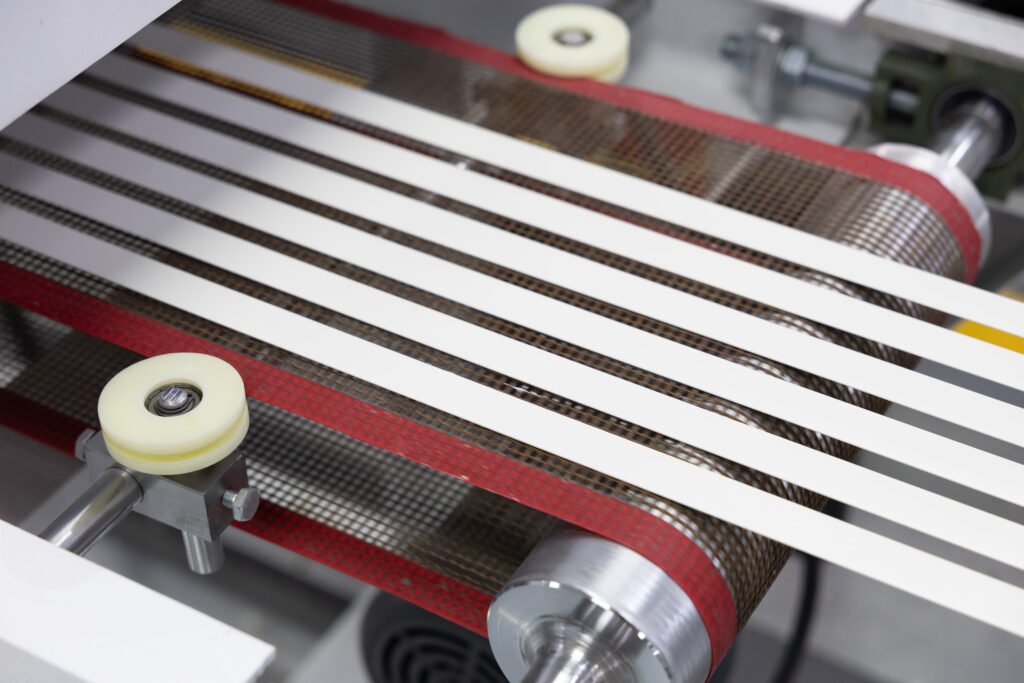
The formulation decides how the material behaves during extrusion and how it performs after it reaches the furniture factory. Two products can both be called PVC edge banding while having different material properties.
What Is the Role of PVC Resin?
PVC resin is the main polymer in the material. It provides the basic structure of the edge band.
REHAU describes PVC as a thermoplastic material with mechanical resistance, impact resistance, chemical resistance, and ageing resistance. REHAU also explains that its PVC edgebands use a specific combination of performance enhancers, stabilizers, lubricants, impact-resistant additives, and pigments.
This tells me that the resin is only the starting point.
The final performance depends on how the different components work together.
Why Are Fillers Used?
Fillers can change the cost, density, hardness, stiffness, and processing behavior of a PVC compound.
Calcium carbonate is one common mineral filler used in PVC compounds. However, I would not treat filler as a simple “good or bad” ingredient.
A formulation needs a suitable balance.
| Formulation component | Main purpose |
|---|---|
| PVC resin | Provides the polymer structure |
| Calcium carbonate and other fillers | Adjusts physical properties and formulation cost |
| Plasticizers | Adjust flexibility and processing behavior |
| Stabilizers | Help protect PVC during processing and use |
| Lubricants | Help control processing and surface behavior |
| Pigments | Provide color and appearance |
| Impact modifiers | Improve resistance to mechanical impact |
| Other additives | Provide application-specific properties |
The exact formulation can vary according to the product design.
For me, this is why a buyer should avoid judging PVC quality from one ingredient alone. A good formulation is a system.
How Does PVC Resin and Filler Content Affect Edge Banding Performance?
The balance between PVC resin and filler can affect hardness, flexibility, density, dimensional stability, surface quality, and machining behavior.
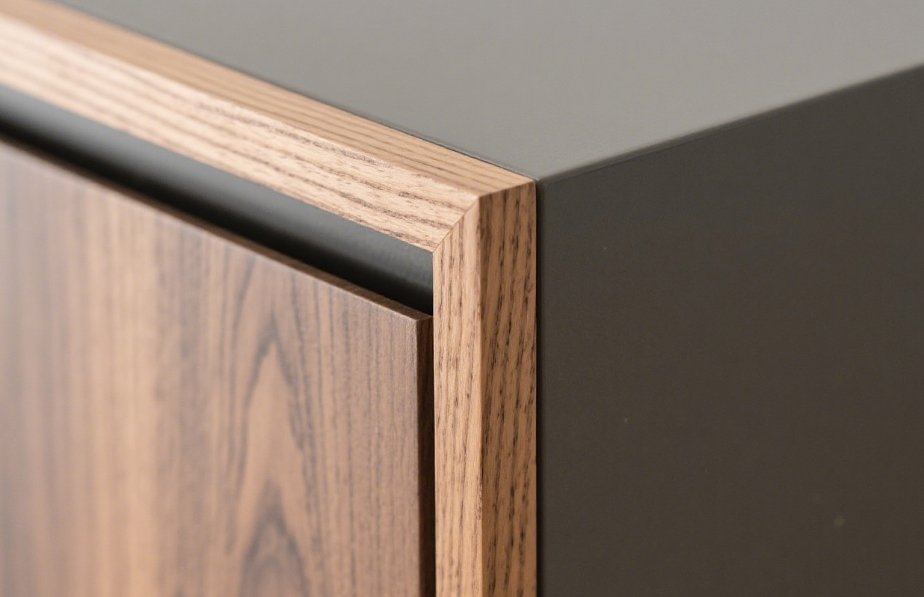
I often see buyers focus on the percentage of one material because it seems easy to compare. But the real question is how the complete formulation performs under the intended application.
Why Does PVC Resin Content Matter?
PVC resin provides the main polymer network. A formulation with a stronger polymer structure can have different mechanical and processing properties from a formulation with a larger amount of mineral filler.
I therefore pay attention to how the edge band behaves rather than looking only at the raw material list.
For example, I want to know:
- Does the edge band bend without cracking?
- Does it machine cleanly?
- Does the surface remain stable after trimming?
- Does it keep its dimensions during processing?
- Does it provide a stable surface for bonding?
- Does it maintain its appearance after finishing?
These questions tell me more about the product’s practical value.
What Happens When Filler Content Changes?
Filler can influence hardness, stiffness, density, and processing behavior. The effect depends on the filler type, particle size, surface treatment, dispersion, and the rest of the formulation.
This point is important because I do not want to make the simple claim that “less filler always means better PVC edge banding.”
That is not a complete way to judge a formulation.
A manufacturer may design different formulations for different applications. A furniture edge band for general indoor use does not necessarily need the same formulation as a product designed for a special application.
SURTECO’s published PVC edgeband data shows that manufacturers can define measurable properties such as Shore hardness, ball indentation hardness, heat distortion resistance, thermal expansion, and shrinkage. Its published PVC product data lists a Shore hardness of 81 ± 3 and shrinkage below 0.3% for the referenced Döllken PVC edgeband.
| Property | Why I care about it |
|---|---|
| Hardness | Affects surface resistance and machining |
| Flexibility | Affects bending and corner processing |
| Density | Helps indicate formulation differences |
| Shrinkage | Affects dimensional stability |
| Heat resistance | Matters during processing and use |
| Surface quality | Affects the final furniture appearance |
So when I compare two PVC edge bands, I prefer measurable performance data over a single statement about raw material content.
How Do Plasticizers and Additives Affect PVC Edge Banding Flexibility and Durability?
Plasticizers and additives help control how PVC edge banding behaves during processing and use. Their selection can affect flexibility, heat stability, surface behavior, impact resistance, and long-term performance.
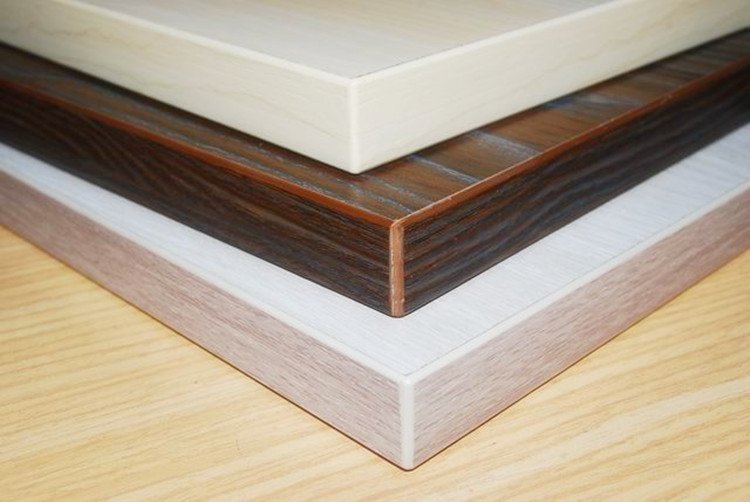
I think this is one of the easiest parts to overlook because buyers usually cannot see additives from the finished edge band.
Why Does Flexibility Matter?
Furniture edge banding does not always stay on a flat straight edge.
Some furniture parts have rounded corners or curved areas. The material may also need to pass through trimming and finishing processes without cracking or losing its appearance.
A formulation that is too rigid may create problems in applications that require more flexibility. A formulation that is designed for more flexibility may behave differently during machining.
This is why I do not want one formulation to be treated as the answer for every application.
What Do Stabilizers Do?
PVC can be affected by heat during processing. Stabilizers help protect the material during processing and can also support long-term material stability.
The role is important because extrusion involves heat. The material must pass through the extrusion process without unacceptable degradation.
A stable formulation should therefore support both processing and final product performance.
What About Lubricants and Impact Modifiers?
Lubricants can help control processing and surface behavior. Impact modifiers can improve resistance to mechanical impact.
REHAU specifically describes its PVC edgeband material as using a combination of performance enhancers, stabilizers, lubricants, impact-resistant additives, and pigments.
That combination shows why I should not judge a PVC formulation by PVC resin and filler alone.
| Additive group | Possible role in PVC edge banding |
|---|---|
| Stabilizers | Support heat stability during processing |
| Lubricants | Help processing and surface behavior |
| Impact modifiers | Improve resistance to impact |
| Pigments | Control color and visual appearance |
| Performance additives | Adjust specific product properties |
The exact additive package is normally part of the manufacturer’s formulation technology.
For a buyer, I do not always need the complete recipe. A supplier may consider the formulation confidential. Instead, I want the supplier to provide the performance data that proves the formulation is suitable for the intended use.
That difference matters.
I am not buying a chemical recipe. I am buying a material that needs to perform consistently.
How Can PVC Formulation Affect Machining, Bonding, and Surface Finish?
PVC formulation can affect how edge banding responds to cutting, trimming, scraping, polishing, heating, and bonding. This means formulation quality can become visible during furniture production.

I see this as the point where formulation becomes a real production issue.
How Does Formulation Affect Machining?
The hardness and flexibility of the PVC can influence how the material reacts to machining tools.
If the material does not match the processing conditions, the factory may see rough edges, poor trimming, surface marks, or other finishing problems.
The machine itself is also important.
REHAU provides dedicated processing information for PVC edgebands and maintains technical information for different edgeband materials. Its current technical resource center includes PVC technical information, delivery specifications, standard tolerances, and processing guidance.
This supports a point I often make:
Material quality and machine performance cannot be separated completely.
Can Formulation Affect Bonding?
Yes, but I would be careful with this point.
Bonding does not depend on PVC formulation alone. The panel surface, adhesive, glue temperature, glue amount, pressure, feed speed, and edge band surface all matter.
So if an edge band has a bonding problem, I would not immediately blame the PVC formulation.
I would check the complete system.
| Production area | What I would check |
|---|---|
| PVC surface | Surface condition and consistency |
| Panel | Edge quality and cleanliness |
| Adhesive | Type and compatibility |
| Temperature | Actual processing temperature |
| Glue amount | Whether coverage is stable |
| Pressure | Contact between edge band and panel |
| Feed speed | Whether processing speed is suitable |
How Does Formulation Affect Surface Finish?
Surface appearance can also be linked to the formulation.
Hardness, pigment dispersion, additives, and processing conditions can all affect the final surface. Gloss and texture may also change when the material is processed under different temperatures or finishing conditions.
This is why I would test a new PVC edge band on the actual furniture production line before placing a large order.
A sample that looks good in the supplier’s showroom is not enough.
I want to see the material after cutting, gluing, trimming, scraping, and polishing.
That is where formulation quality becomes a real production result.
How Should Furniture Manufacturers Evaluate PVC Edge Banding Formulation When Buying?
Furniture manufacturers should evaluate PVC edge banding by measurable performance, processing results, batch consistency, and application requirements instead of judging the formulation from price or one raw material ratio.

When I buy PVC edge banding, I want to know what I am actually paying for.
A low price can come from many factors. Some can be efficient production. Some can be material choices. The price itself cannot tell me whether the product is suitable.
What Technical Data Should I Ask For?
I would first ask the supplier for a technical data sheet.
I would look for measurable information such as:
- Thickness and width tolerance
- Hardness
- Shrinkage
- Heat resistance
- Light resistance
- Surface characteristics
- Processing recommendations
- Storage requirements
- Recommended applications
REHAU currently provides technical delivery specifications and standard tolerances for PVC and ABS edgebands.
SURTECO also publishes measurable PVC edgeband properties such as Shore hardness, Vicat heat distortion resistance, thermal expansion, light resistance, and shrinkage.
For me, this is much more useful than simply asking a supplier:
“Is your PVC high quality?”
Almost every supplier can answer yes.
Technical data gives me something I can compare.
Should I Ask About the Exact Formulation Ratio?
I can ask, but I should understand that the supplier may not disclose its complete formulation.
The better approach is to ask about the performance target.
For example, instead of asking only:
“How much calcium carbonate do you use?”
I can ask:
“What hardness, shrinkage, flexibility, and processing performance does this formulation achieve?”
This question focuses on the result.
Should I Test Samples Before Buying in Bulk?
Yes.
I would test the edge band under the same or similar conditions used in mass production.
| Evaluation stage | What I want to know |
|---|---|
| Visual inspection | Is the color and surface consistent? |
| Dimensional inspection | Are thickness and width stable? |
| Bending test | Does the edge band crack or deform? |
| Machining test | Does trimming remain clean? |
| Bonding test | Does the edge band bond well with the panel? |
| Finishing test | Does scraping and polishing produce the expected surface? |
| Batch test | Does a second batch perform similarly? |
I would also keep a reference sample from an approved batch.
This gives me a physical comparison when a future batch arrives.
For distributors, this is even more important. A distributor may sell the same product to many furniture manufacturers. A formulation that works for one customer may not work equally well for another customer’s machine and production process.
I therefore see formulation evaluation as a performance verification process, not a simple raw material inspection.
When I choose a supplier, I want three things at the same time: clear specifications, repeatable production, and technical support when the material enters a real furniture factory.
Conclusion
PVC formulation affects edge banding through the balance of resin, fillers, plasticizers, stabilizers, pigments, and additives, which together determine processing and final performance.
Data source
The technical content of this article mainly refers to the following public technical documents:
- REHAU — RAUKANTEX PVC Technical InformationREHAU RAUKANTEX PVC Technical Information
- REHAU — Tools & Services / Technical InformationREHAU Tools & Services
- REHAU — Technical Information for Interior DesignREHAU Technical Information
- SURTECO / Döllken — PVC Edgebands Processing InformationSURTECO PVC Edgebands Technical Information