A poor edge band can peel, crack, or lose its appearance after daily use, which can turn a small material choice into a real furniture quality problem.
I choose PVC edge banding by checking the furniture’s use, material, thickness, width, surface finish, quality, and supplier consistency before production.
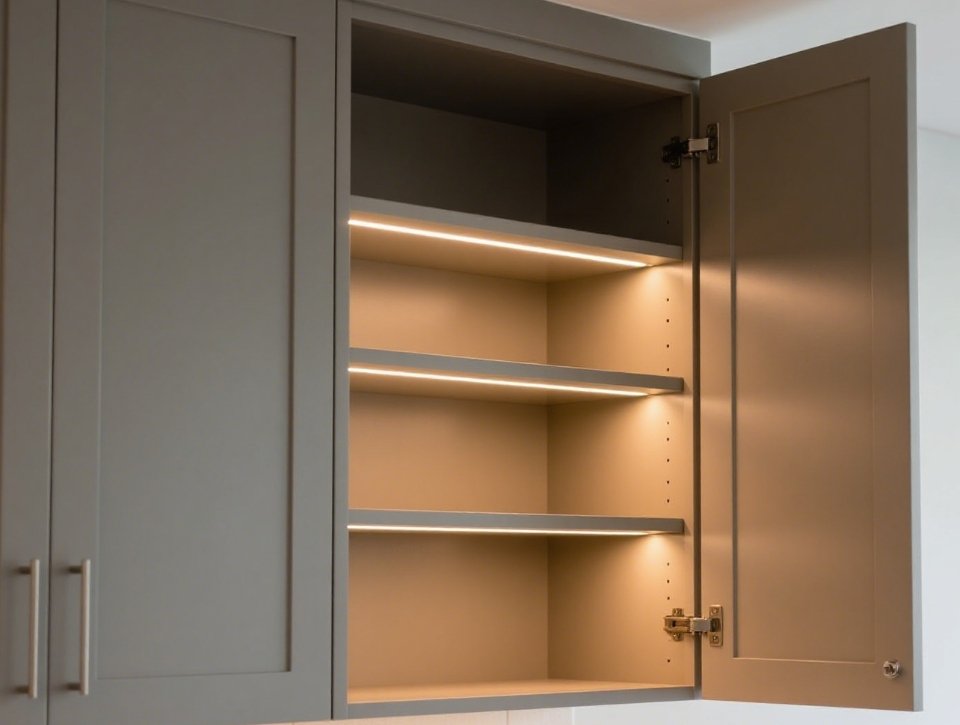
I do not think there is one PVC edge banding specification that works for every cabinet. Kitchen cabinets face moisture, heat, cleaning, impact, and daily handling. Commercial furniture can face even more frequent use. I therefore look at the whole application before I choose the edge banding. The right choice should work well during production and keep its appearance after installation.
What Should You Consider When Choosing PVC Edge Banding for Kitchen Cabinets?
Kitchen cabinets face more daily stress than many decorative furniture products. If I choose an edge band only because it looks good, I may create problems later.
I first check moisture, cleaning, impact, temperature, and the frequency of use before I select PVC edge banding for a kitchen cabinet.

I Start With the Cabinet’s Working Environment
I first ask where the cabinet will be used.
A kitchen cabinet may be exposed to water around the sink. It may also face steam, food stains, cleaning products, and repeated opening and closing. The edge is often one of the most exposed parts of the panel.
I therefore care about more than the appearance of the PVC surface.
I check whether the edge band can maintain stable dimensions during normal processing and use. I also check whether the bonding system can create a stable connection between the edge band and the board.
The European Panel Federation notes that moisture resistance is an important consideration for wood-based panels in applications where moisture exposure can occur. This matters because the edge band and the panel should work as one finished edge rather than as two unrelated materials.
I Look at Cleaning and Daily Contact
I also think about how people use kitchen furniture.
A cabinet door may be opened many times each day. The edge may be touched, wiped, and exposed to small impacts. The area around handles and corners can receive even more contact.
For this reason, I do not judge a PVC edge band only by a showroom sample.
I want to know how the finished edge behaves after repeated use.
| Kitchen cabinet condition | What I check |
|---|---|
| Near sink | Moisture exposure and bonding |
| Near cooking area | Heat exposure and surface stability |
| Frequently cleaned | Surface and chemical resistance |
| High-use doors | Impact and bonding strength |
| Visible front edges | Color and surface finish |
| Cabinet corners | Trimming and edge quality |
I Match the Edge Band to the Board and Adhesive
I also check the relationship between the edge band, panel, and adhesive.
A good PVC edge band cannot compensate for a poor production process. The final result depends on the surface condition, adhesive system, temperature, feed speed, pressure, and machine settings.
HOMAG explains that edge banding machines use different processing systems and parameters for edge materials and applications. This is one reason I do not treat the edge band as an isolated component.
I also check whether the supplier can provide technical information for the product. A serious supplier should be able to explain recommended processing conditions and suitable applications.
Which PVC Edge Banding Material and Thickness Are Best for High-Use Furniture?
I do not choose thickness by assuming that thicker always means better. I choose it according to the furniture design, edge exposure, processing method, and expected level of use.
For high-use furniture, I normally compare PVC specifications based on durability, processing performance, appearance, and application requirements rather than price alone.
I Understand Why PVC Is Used
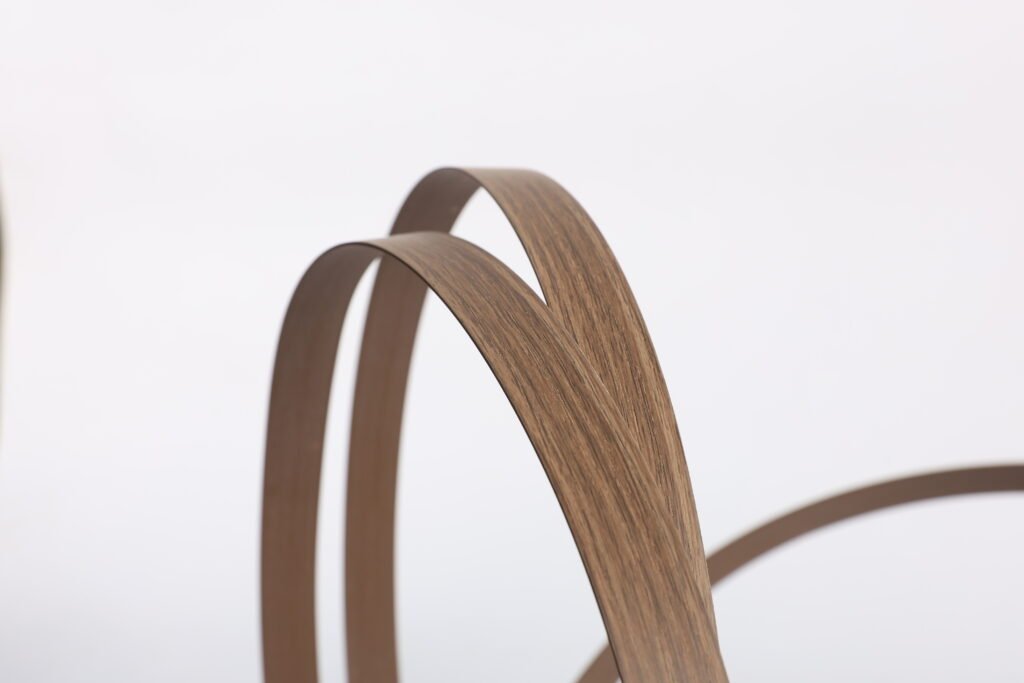
PVC is widely used for furniture edge banding because it can provide a consistent decorative surface and can be produced in many colors, patterns, and dimensions.
The European Chemicals Agency identifies PVC as polyvinyl chloride, a thermoplastic polymer used in many applications. Furniture edge banding is one example of a finished PVC product rather than raw PVC resin.
I focus on the finished product’s actual properties when I make a purchasing decision.
I check the edge band’s surface, flexibility, dimensional stability, color consistency, and processing behavior.
I Choose Thickness Based on Application
Thickness affects the visual appearance and physical characteristics of the finished edge.
A thin edge band may be suitable for some standard furniture panels. A thicker edge band can create a more substantial visual edge and may be suitable for applications where the edge receives more impact.
But I do not automatically select the thickest option.
A thicker product can also change cutting, trimming, bending, and machine-setting requirements.
REHAU’s furniture edgeband product information shows that edgebands are available in different thicknesses and widths for different furniture applications. Its RAUKANTEX range includes PVC and other material options for furniture surfaces.
| Factor | Thinner PVC edge band | Thicker PVC edge band |
|---|---|---|
| Visual effect | Light and simple | More substantial |
| Material use | Lower | Higher |
| Processing | Often easier | May need different settings |
| Edge protection | Application dependent | Application dependent |
| Cost per meter | Usually lower | Usually higher |
| Best choice | Depends on furniture | Depends on furniture |
I use this table as a decision framework, not as a rule that one thickness is always better.
I Consider PVC and Alternative Edge Materials
I also compare PVC with other edge banding materials when the application requires it.
Furniture suppliers can use materials such as ABS, PP, PMMA, and real wood veneer. REHAU, for example, offers edgebands in several material groups and provides application information for furniture manufacturers.
For a standard high-use kitchen cabinet, I may still choose PVC because of its balance of appearance, processability, and cost.
For another furniture project, I may need a different material because of design or technical requirements.
I therefore ask one simple question before choosing:
What does the finished furniture need to do?
That question is more useful than asking which edge band is the strongest in general.
How Do PVC Edge Banding Width, Thickness, and Surface Finish Affect Cabinet Performance?
I often see buyers focus on color first. I understand why. The color is easy to see. But width, thickness, and surface finish can also affect the final cabinet result.
I choose width, thickness, and surface finish together because these specifications affect both the appearance and the production process.
I Match Width to the Panel
I first check the board thickness and the required finished edge.
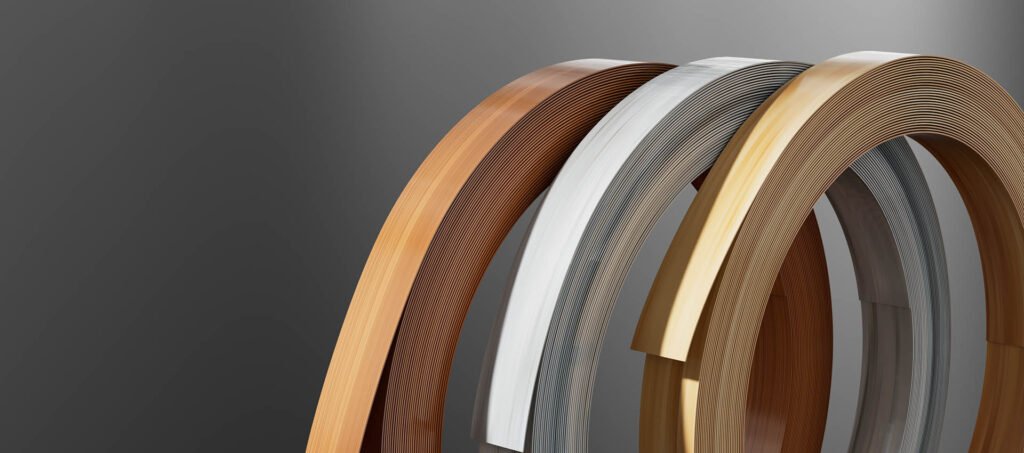
The edge band needs enough width to cover the panel edge and allow proper trimming. If the width is too small, the finished edge may not be properly covered. If the width is much larger than necessary, I may create more trimming waste.
For example, if I use a 18 mm furniture board, I may select an edge band width that gives the production line enough material for reliable trimming.
The exact width depends on the board, machine, trimming method, and finished design.
REHAU provides edgebands in different widths and thicknesses, which shows why furniture manufacturers need to select dimensions according to the application rather than use one standard size for every project.
I Look at Surface Finish as Part of the Design
Surface finish affects how the furniture looks and how easily small marks are noticed.
I may choose a matte surface for one kitchen design and a high-gloss surface for another. Woodgrain, stone effects, solid colors, and other decorative finishes can also change the visual result.
I pay special attention to color matching when the edge band is used with a decorative board.
The edge should look like part of the panel. A small difference in color, gloss, or texture can become obvious when the edge is close to the main furniture surface.
I Consider Processing When I Choose Specifications
I also check whether the selected specification works with my edge banding machine.
The machine needs to apply adhesive, press the edge band, trim the excess material, and finish the edge. The edge band must work well within these steps.
HOMAG provides edge banding machines with different feed speeds and processing configurations. For example, its EDGETEQ S-240 is specified with an 11 m/min feed speed, while other machines in its range are designed for different production requirements.
I do not use machine speed as a direct measure of edge band quality. I use it to understand the production conditions in which the edge band will be processed.
| Specification | Question I ask |
|---|---|
| Width | Does it cover the panel with enough trimming allowance? |
| Thickness | Does it match the design and processing method? |
| Surface | Does it match the furniture’s visual requirement? |
| Color | Does it match the board closely? |
| Flexibility | Can the machine process it correctly? |
| Backing/primer | Is it suitable for the selected adhesive system? |
How Can You Check PVC Edge Banding Quality Before Production?
I do not wait until mass production to discover an edge band problem. I check samples before I place a large order.
I use sample testing to check dimensions, appearance, bonding, processing behavior, and batch consistency before production.

I Start With Basic Measurements
I first check the dimensions.
I measure width and thickness at several points instead of checking only one location. This helps me identify whether the product has stable dimensions.
I also check the surface for scratches, color variation, bubbles, contamination, or other visible defects.
EGGER publishes technical information for its PVC edging products that includes physical and processing-related properties. This is useful to me because a technical datasheet gives me measurable information instead of only marketing language.
I Test the Finished Edge, Not Only the Raw Material
I think this is one of the most important steps.
A PVC edge band may look perfect before production. The real test starts when I run it through the edge banding machine.
I test a sample panel using the same or similar production conditions that I will use for mass production.
I check:
- Adhesion
- Trimming quality
- Surface appearance
- Corner performance
- Color matching
- Edge alignment
- Glue line appearance
- Resistance to normal handling
I do not rely on one test alone.
I Ask for Technical Data
I also ask the supplier for a technical datasheet.
A useful datasheet should identify the material and provide relevant technical properties and processing information.
EGGER’s PVC edging technical datasheet, for example, provides measured technical information rather than only general product descriptions.
I can then compare suppliers using similar information.
| Quality item | What I check before production |
|---|---|
| Dimensions | Width and thickness consistency |
| Appearance | Color, gloss, texture, and surface defects |
| Processing | Trimming and machine performance |
| Adhesion | Bonding after processing |
| Color matching | Match with the selected board |
| Batch consistency | Difference between samples and production batch |
| Documentation | Technical data and specifications |
I Use a Small Trial Order Before a Large Order
I prefer a trial order when the project is important.
A small order gives me a chance to check actual production behavior. It also helps me find problems before the material reaches a large production run.
For a long-term B2B relationship, I think this step is more useful than choosing a supplier from a quotation sheet alone.
How Can Furniture Manufacturers Choose the Right PVC Edge Banding Supplier?
I do not choose a supplier only because the supplier offers a low price. I need a supplier that can keep the same standard after the first order.
For furniture manufacturers, I compare suppliers by quality consistency, color matching, technical support, customization, lead time, and long-term supply capacity.

I Check Whether the Supplier Understands Furniture Production
A supplier should understand more than PVC.
I want the supplier to understand panel furniture, edge banding machines, common processing problems, color matching, and production requirements.
This matters when I need a custom color or when I face an unexpected production issue.
A supplier that only gives me a price may not be enough for a long-term furniture project.
I Compare More Than the Quotation
I usually compare suppliers across several points.
| Supplier factor | Why I check it |
|---|---|
| Product quality | It affects finished furniture |
| Color matching | It affects visual consistency |
| Specification range | It affects product selection |
| MOQ | It affects inventory and cash flow |
| Lead time | It affects production planning |
| Customization | It supports special projects |
| Technical support | It helps solve processing problems |
| Quality control | It affects batch consistency |
| Production capacity | It affects long-term supply |
| Export experience | It can reduce international purchasing risks |
This approach helps me avoid a common mistake.
I may save $0.01 per meter with a cheaper supplier, but I may lose much more if the supplier delivers inconsistent colors or unstable dimensions.
I Look for Stable Batch Quality
For a furniture manufacturer, the first shipment is not enough.
I need the second, third, and tenth shipment to remain consistent.
This is especially important when the same furniture design stays in production for months or years.
If the color changes between batches, I may have to separate inventory or replace finished components. That creates a cost that does not appear on the original quotation.
I therefore ask suppliers about their quality control process, production records, inspection standards, and batch management.
I Think About the Supplier Relationship
I also consider communication speed.
A furniture factory may need a new color, a different width, a sample, or a technical answer quickly.
A supplier that can respond clearly can reduce production delays.
I also prefer suppliers that can support both standard products and customized requirements. This is useful when I develop new furniture collections or need to match a new decorative board.
For me, the right PVC edge banding supplier is not simply the supplier with the lowest price. It is the supplier that can provide the right specification, stable quality, reliable production support, and predictable supply over time.
Conclusion
I choose PVC edge banding by matching performance, specifications, quality, and supplier reliability to the real demands of each furniture application.
Data Sources
European Chemicals Agency — PVC Substance Information
European Chemicals Agency — PVC Information
REHAU — Furniture Edgebands and RAUKANTEX
REHAU Furniture Edgebands
EGGER — Technical Datasheet: EGGER PVC Edge Banding
EGGER PVC Edge Banding Technical Datasheet
HOMAG — Edge Banding Machines
HOMAG Edge Banding Machines
European Panel Federation — Wood-Based Panel Industry Information
European Panel Federation