

Importing edge banding without checking chemical compliance can lead to customs delays, rejected shipments, and unexpected costs. A low purchase price means little if the product cannot enter your target market.
I verify edge banding compliance by checking the destination country’s chemical regulations, reviewing the material composition, requesting valid test reports and declarations, and confirming that the documents match the actual products being shipped.

When I work with overseas buyers, I find that many focus on price, color matching, thickness, and delivery time. These factors are important, but they do not cover every risk involved in international purchasing. Different countries have different rules for imported materials, and the same edge banding product may face different requirements in different markets. Buyers need to check these requirements before they place a bulk order. I will explain how I approach this process and what I believe buyers should ask their suppliers before importing edge banding.
What Compliance Requirements Apply to Imported Edge Banding Products?
Import requirements depend on the destination market, product composition, and intended application. Buyers must identify applicable chemical restrictions, product standards, labeling rules, and customs requirements before importing.

I Always Start With the Destination Market
I do not think buyers should ask suppliers for a general compliance certificate without first identifying the destination country.
The European Union, the United States, the United Kingdom, and Canada have different regulatory systems. Some rules focus on restricted chemical substances. Others focus on chemical exposure, formaldehyde emissions, or specific product categories.
For example, buyers importing PVC edge banding into the European Union should pay attention to REACH. REACH regulates chemicals and places restrictions on certain substances in products. Its Candidate List also creates communication and notification obligations for articles containing substances of very high concern (SVHCs).
According to the European Chemicals Agency (ECHA), suppliers of articles containing Candidate List substances above 0.1% by weight must provide sufficient information for safe use. Certain importers also have notification obligations when the relevant annual tonnage exceeds one tonne. These are separate obligations, and buyers should not confuse them. Source: ECHA.
For buyers importing edge banding into the United States, TSCA is another regulation worth checking. The US Environmental Protection Agency explains the import certification requirements for chemical substances, mixtures, and certain articles containing chemical substances or mixtures. Importers should confirm the applicable certification treatment for their specific products rather than assume that every finished article follows the same procedure. Source: EPA.
Which Regulations Should Edge Banding Buyers Pay Attention To?
I usually divide the main regulatory checks into several groups.
| Regulation or requirement | Main market | What buyers should check |
|---|---|---|
| REACH | EU/EEA | SVHC substances and applicable Annex XVII restrictions |
| POPs Regulation | EU | Restricted persistent organic pollutants in products |
| TSCA | United States | Applicable chemical import and certification requirements |
| California Proposition 65 | California | Listed chemical exposure and warning requirements |
| TSCA Title VI | United States | Requirements for regulated composite wood products in applicable finished goods |
| UK REACH | Great Britain | SVHC communication and applicable substance restrictions |
The EU POPs Regulation is also important because it prohibits or restricts certain persistent organic pollutants in substances, mixtures, and articles. Buyers should check the applicable substance limits and exemptions. Source: EUR-Lex.
I also want to make one point clear about TSCA Title VI. This regulation focuses on formaldehyde emissions from regulated composite wood products, including hardwood plywood, MDF, and particleboard, as well as applicable finished goods containing them. It does not automatically mean that every PVC or ABS edge banding roll needs a TSCA Title VI certificate. Buyers need to check whether the imported product actually falls within the regulated product categories. Source: EPA.
Why Does the Material Type Matter?
I never treat all edge banding materials as the same product.
PVC, ABS, PP, acrylic, and wood veneer have different chemical compositions and manufacturing processes. Their additives, pigments, stabilizers, coatings, and primers may also differ.
For example, PVC edge banding uses a different polymer system from ABS edge banding. The additives used in the production process may also vary between suppliers.
This is why I believe buyers should identify the exact material before deciding which compliance tests to request.
How Can Buyers Check Edge Banding Materials Against Chemical Regulations?
Buyers should identify the complete material composition, compare relevant substances against destination-market restrictions, and use suitable laboratory tests to verify potential chemical risks. A material name alone cannot prove compliance.

I Do Not Rely on the Material Name Alone
When I evaluate an edge banding product, I first look at its material composition.
A supplier may describe a product as PVC edge banding, but this description does not explain every substance used during production. The final product may contain pigments, stabilizers, processing aids, impact modifiers, surface coatings, and primers.
These components can affect the chemical properties of the finished product.
I believe buyers should ask suppliers to provide a material declaration that covers the main polymer and relevant additives. The supplier does not always need to disclose its entire proprietary formula. However, it should provide enough information to assess the substances that may be restricted by the destination market.
For example, I would ask whether the supplier has assessed the product against relevant REACH SVHC requirements and applicable restrictions under Annex XVII.
ECHA explains that Annex XVII contains restrictions on certain substances in substances, mixtures, and articles. These restrictions must be checked against the relevant conditions and product categories. Source: ECHA.
Which Chemical Substances Should Buyers Pay Attention To?
I would not recommend testing every edge banding product for every chemical on every regulatory list. That approach can increase costs without giving buyers useful information.
Instead, I would first assess the material, its formulation, and its intended application.
The following table shows examples of substances or substance groups that buyers may need to assess. Their relevance depends on the formulation and applicable regulations.
| Substance or substance group | Why buyers may need to check it | Possible relevance |
|---|---|---|
| Phthalates | Some phthalates are restricted in specific applications and product categories | Certain PVC formulations |
| Lead and cadmium | Heavy metals may be restricted in products or specific applications | Pigments, stabilizers, and additives |
| Organotin compounds | Some organotin substances face restrictions | Certain PVC formulations and stabilizer systems |
| PAHs | Certain PAHs are restricted in specified consumer articles | Rubber or plastic components and certain materials |
| PFAS | Certain PFAS are subject to existing or developing restrictions | Relevant additives, coatings, or processing materials |
| Formaldehyde | Relevant to applicable composite wood products and certain chemical exposures | Wood-based products and related components |
I want to stress that the presence of a substance does not automatically mean that a product violates the law. The applicable restriction, concentration limit, product category, and intended use all matter.
How Do I Match Chemical Tests With Different Materials?
I would use a risk-based approach instead of asking every supplier for the same test package.
For PVC edge banding, I would first review the formulation and identify relevant plasticizers, stabilizers, pigments, and other additives.
For ABS and PP edge banding, I would focus on the polymer formulation, pigments, impact modifiers, and processing additives.
For acrylic edge banding, I would review the polymer system, coatings, pigments, and surface treatments.
For wood veneer edge banding, I would pay more attention to the wood-based components, coatings, adhesives, and any applicable formaldehyde requirements.
I would then ask an accredited laboratory to select suitable analytical methods based on the applicable regulatory limits.
This step is important because a laboratory report should answer a specific compliance question. A report showing that a product passed one heavy-metal test cannot prove that it complies with every REACH restriction.
Which Compliance Documents and Test Reports Should Buyers Request from Suppliers?
I recommend requesting a product-specific material declaration, applicable regulatory compliance declaration, relevant laboratory test reports, and supporting quality documents. Each document should identify the product and its tested specifications.

I Always Ask for More Than a General Certificate
In my experience, one of the biggest mistakes buyers make is treating a certificate as complete proof of product compliance.
A supplier may send an ISO 9001 certificate, a company registration document, or a general quality certificate. These documents can help buyers understand the supplier’s management system, but they do not automatically prove that a particular edge banding product meets chemical regulations.
I separate supplier qualifications from product compliance.
For example, ISO 9001 relates to quality management systems. It does not certify that every product manufactured by a company meets REACH or TSCA requirements.
I would therefore ask suppliers to prepare a document package based on the actual material and destination market.
My Recommended Compliance Document Checklist
| Document | What I want to verify | Priority |
|---|---|---|
| Material Declaration | Main polymer, additives, and relevant material information | High |
| REACH SVHC Declaration | Status against the applicable Candidate List | High for EU buyers |
| REACH Annex XVII Test Report | Compliance with relevant restricted substances | High when applicable |
| POPs Test Report or Declaration | Relevant POPs restrictions | According to material risk |
| Laboratory Test Report | Actual analytical results for selected substances | High |
| TSCA Compliance Documentation | Applicable US chemical import requirements | According to product and import status |
| Proposition 65 Assessment | Relevant listed substances and exposure risks | For California market |
| ISO 9001 Certificate | Supplier’s quality management system | Supporting document |
| Product Specification Sheet | Material, thickness, width, finish, and other specifications | High |
| Batch or Lot Identification | Connection between the tested sample and production batch | High |
I would also request the laboratory’s full report instead of accepting a one-page certificate that only says PASS.
A useful report should include the product name, sample description, material identification, test date, testing methods, results, limits, and laboratory details.
Why Do Test Reports Need to Match the Actual Product?
I believe this is one of the most important parts of the entire process.
Imagine that a buyer orders 1 mm PVC edge banding in a particular color. The supplier sends a REACH test report for 2 mm white PVC edge banding.
Can the buyer use that report to prove that the new product complies?
I would not accept it without further evidence.
The two products may use different formulations, pigments, or additives. Their production batches may also have different raw material sources.
A test report should represent the actual product or a clearly justified product family. If a supplier uses one representative sample for several colors or thicknesses, the supplier should explain why the tested sample represents those products.
For this reason, I recommend that buyers connect compliance documents with product codes, material specifications, colors, thicknesses, and production batches.
How Can Buyers Verify Whether Compliance Documents Are Valid and Reliable?
Buyers should check the issuing laboratory, accreditation scope, report number, testing methods, sample identification, and report date. They should also confirm that the tested sample represents the products in the purchase order.

I Check the Laboratory Before I Trust the Report
A document can look professional and still provide weak evidence.
When I receive a laboratory report, I first check who issued it.
I prefer reports from laboratories accredited to ISO/IEC 17025 for the relevant testing activities. This standard covers the competence of testing and calibration laboratories.
However, I do not assume that an ISO/IEC 17025 logo automatically proves that every test in the report falls within the laboratory’s accredited scope.
I would check the laboratory’s accreditation body and its published scope. I would also confirm that the relevant chemical testing method is included.
For international buyers, accreditation bodies that are signatories to the ILAC Mutual Recognition Arrangement can provide additional confidence in the recognition of laboratory accreditation.
Buyers can use the official ILAC website to find information about recognized accreditation arrangements.
My Six-Step Method for Checking a Test Report
I would follow these steps before accepting a compliance report.
| Step | What I check | What I want to confirm |
|---|---|---|
| 1 | Laboratory name | The laboratory exists and can be contacted |
| 2 | Accreditation | Relevant testing activities fall within its scope |
| 3 | Report number | The report can be independently verified |
| 4 | Sample description | The sample matches the ordered material |
| 5 | Test method and results | The method and results support the compliance claim |
| 6 | Report date | The report is still relevant to the current product and regulations |
I would also contact the laboratory directly when the report’s authenticity is uncertain. I would use the laboratory’s official contact information instead of relying only on contact details provided in an unverified document.
Why Is the Test Date Important?
Chemical regulations can change. Suppliers can also change their raw materials and production processes.
A report from several years ago may not cover a recently added restriction or a new product formulation.
For example, the EU REACH Candidate List is updated over time. Buyers should compare the date of the supplier’s declaration with the current list when they review an order.
I would also ask whether the supplier has changed its raw materials, pigments, additives, or manufacturing processes since the test was completed.
A report does not become automatically invalid simply because it is old. However, buyers need evidence that the tested formulation is still representative and that the report covers the current regulatory requirements.
What Should Buyers Do When a Supplier Refuses Verification?
I would treat refusal to provide basic verification information as a warning sign.
A supplier may have legitimate reasons to protect its proprietary formulation. I do not expect manufacturers to disclose every production detail.
However, a professional supplier should be able to provide suitable compliance declarations, relevant test results, and a way to verify the authenticity of its documents.
If the supplier cannot provide this information, I would consider independent testing before approving a large order.
How Can Buyers Confirm That an Edge Banding Supplier Meets Import Requirements?
Buyers should connect supplier qualifications, product specifications, compliance evidence, and shipment records. They should also confirm that the supplier can maintain the same material standards throughout mass production.
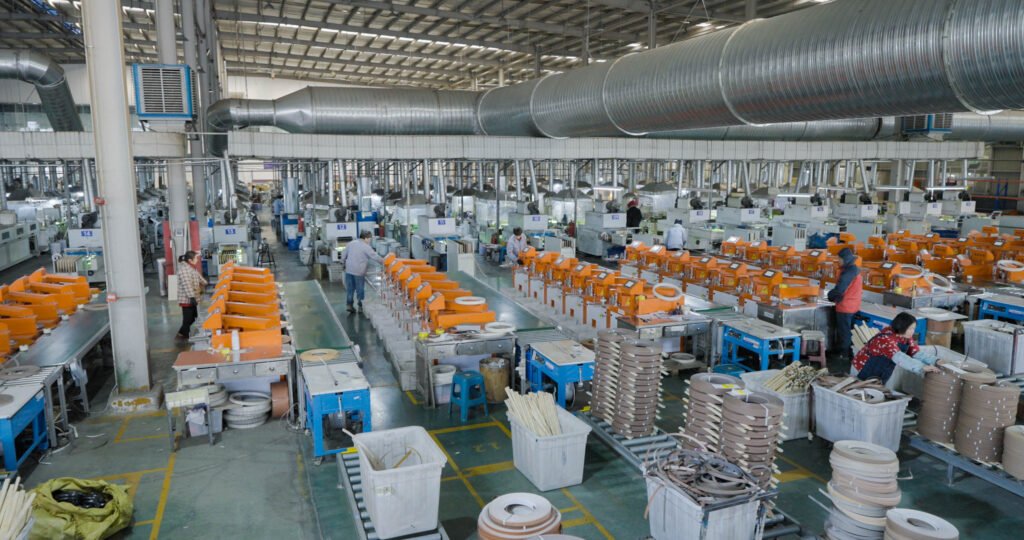
I Look at the Supplier’s Production Control, Not Just Its Certificates
I believe a supplier’s compliance ability is closely related to its production management.
A manufacturer may have a valid laboratory report for one sample. However, the actual production process may use different raw materials or additives.
This creates a gap between sample approval and mass production.
When I evaluate a manufacturer, I want to understand how it controls raw materials, production batches, product specifications, and quality inspections.
I would ask the following questions:
- Does the supplier have a controlled raw material purchasing process?
- Does the supplier record the material batches used in production?
- Can the supplier trace a finished product back to its raw materials?
- Does the supplier control changes in additives and pigments?
- Does the supplier maintain consistent product specifications?
- Can the supplier provide updated compliance documents when the formulation changes?
These questions help buyers understand whether a manufacturer can maintain product consistency after the first order.
For distributors, this is especially important. A single non-compliant shipment can affect customer relationships, inventory turnover, and future purchasing decisions.
I Use a Pre-Import Verification Process
I prefer to divide the verification process into several stages.
| Stage | Buyer’s action | Expected result |
|---|---|---|
| Before quotation | Identify destination market and product requirements | Clear compliance checklist |
| Before sampling | Request material declaration and available reports | Initial compliance review |
| Sample approval | Check sample specifications and arrange testing if needed | Approved product reference |
| Before mass production | Confirm formulation and material specifications | Controlled production requirements |
| Before shipment | Review batch records and final documentation | Shipment-ready compliance evidence |
| After delivery | Retain records and inspect received products | Traceability and future reference |
I would also make sure that the purchase agreement clearly states the approved material, thickness, width, color, surface finish, and relevant compliance requirements.
If a supplier changes the formulation or raw material source, the supplier should inform the buyer before using the new material in production.
This is not just a quality control issue. It is also a compliance control issue.
What Should Buyers Put in Their Purchase Agreement?
I recommend including specific compliance responsibilities in the purchase agreement instead of relying on general promises.
For example, buyers can require the supplier to:
- Provide accurate product-specific compliance declarations.
- Supply valid laboratory reports for agreed regulatory requirements.
- Notify the buyer before changing relevant raw materials or formulations.
- Maintain production batch traceability.
- Provide supporting documents for customs and import procedures when required.
- Cooperate with reasonable independent testing requests.
I also recommend that buyers clarify who will be responsible for additional testing, product replacement, and other costs if a shipment fails an agreed compliance requirement.
The exact responsibilities should be agreed upon before production begins.
My View: Compliance Should Be Part of Supplier Selection
I have always believed that choosing an edge banding supplier should involve more than comparing quotations.
A manufacturer with a lower price may appear attractive at the beginning. But if the supplier cannot provide reliable product information, maintain stable raw materials, or support import documentation, the buyer may face much higher costs later.
For distributors, compliance is also part of long-term business development. Their customers expect stable products, reliable delivery, and consistent quality.
I would rather work with a supplier that can explain its production process and support its compliance claims than one that simply promises that everything is fine.
At the same time, I do not think buyers should demand every possible certificate from every supplier. They should request the documents that match the actual product and destination market.
This is a more practical way to control costs and reduce import risks.
Tell Us Your Target Market
EU, US or UK — send the destination market together with the material and thickness, and we confirm which declarations, test reports and batch records your shipment needs.
Request Compliance Documents
Conclusion
I believe buyers should verify material composition, applicable regulations, laboratory evidence, and production traceability before importing. Compliance should be confirmed before bulk production, not after shipment.
Data Sources and Regulatory References
The following sources are official regulatory or accreditation resources. I recommend using them to verify the latest requirements before placing an import order.
- European Chemicals Agency (ECHA) – REACH Candidate List Obligations
https://echa.europa.eu/en-GB/web/guest/candidate-list-obligations
Information about SVHC communication, notification, and SCIP-related obligations. - European Chemicals Agency (ECHA) – REACH Restrictions
https://echa.europa.eu/en-GB/support/restriction
Information about substances restricted under REACH Annex XVII. - European Chemicals Agency (ECHA) – REACH and CLP for Non-EU Companies
https://echa.europa.eu/support/getting-started/enquiry-on-reach-and-clp
Guidance for non-EU manufacturers supplying products to the European market. - EUR-Lex – Regulation (EU) 2019/1021 on Persistent Organic Pollutants
https://eur-lex.europa.eu/eli/reg/2019/1021/2025-08-04/eng
Official EU legal text covering POPs restrictions. - US Environmental Protection Agency (EPA) – TSCA Requirements for Importing Chemicals
https://www.epa.gov/tsca-import-export-requirements/tsca-requirements-importing-chemicals
Information about TSCA import certification requirements. - US Environmental Protection Agency (EPA) – Formaldehyde Standards for Composite Wood Products
https://www.epa.gov/formaldehyde/frequent-questions-regulated-stakeholders-about-implementing-formaldehyde-standards
Guidance on TSCA Title VI requirements for regulated composite wood products and applicable finished goods. - California Office of Environmental Health Hazard Assessment (OEHHA) – Proposition 65 Business Requirements
https://oehha.ca.gov/proposition-65/businesses-and-proposition-65
Information about chemical exposure warnings and business responsibilities in California. - International Laboratory Accreditation Cooperation (ILAC)
https://ilac.org/
Information about laboratory accreditation and international recognition arrangements.
Note: This article provides general guidance for commercial buyers. The applicable legal requirements depend on the destination market, product composition, intended use, and current regulations. Buyers should confirm specific obligations with the relevant authorities, customs brokers, or qualified compliance professionals before importing.